

Sustainable Solutions for Chemical and Hazardous Waste Management
Table of Contents
- 1 Understanding the Intersection of Regulated Medical Waste and Chemical Waste Management
- 2 How Many Regulated Medical Waste Classes Exist?
- 3 State-Specific Variations in Regulated Medical Waste Classifications
- 4 Best Practices for Handling, Packaging, and Disposing of Regulated Waste
- 5 Frequently Asked Questions about Regulated Waste
- 6 Conclusion
Understanding the Intersection of Regulated Medical Waste and Chemical Waste Management

The management of waste in healthcare and laboratory environments presents a multifaceted challenge, particularly when dealing with both regulated medical waste (RMW) and various hazardous chemicals. Regulated medical waste, often known as biomedical or biohazardous waste, primarily consists of non-hazardous materials that are potentially infectious. These materials pose a risk to human health or the environment due to the potential spread of harmful microorganisms. Concurrently, many healthcare and research facilities also generate chemical waste, which falls under a separate, equally stringent regulatory framework.
The intersection of these two waste streams necessitates meticulous attention to detail and a comprehensive understanding of diverse regulatory guidelines. Federal agencies such as the Environmental Protection Agency (EPA), the Occupational Safety and Health Administration (OSHA), and the Department of Transportation (DOT) establish broad guidelines that serve as the foundation. However, individual states and even local authorities often adapt and expand upon these federal mandates, leading to a complex patchwork of regulations. Effective waste management thus requires not only adherence to these guidelines but also a proactive approach to segregation and disposal to mitigate risks and ensure compliance.
Integrating Chemical Waste Management with Medical Waste Protocols
Effective waste management begins with precise waste segregation at the point of generation. This critical step prevents the commingling of different waste types, which can lead to increased disposal costs, regulatory non-compliance, and heightened safety risks. Regulated medical waste, characterized by its infectious potential, must be kept separate from chemical waste, which is classified under the Resource Conservation and Recovery Act (RCRA) as hazardous waste due to its toxic, corrosive, reactive, or ignitable properties.
However, the reality in many healthcare and laboratory settings is that waste can sometimes possess characteristics of both. For instance, a culture containing a hazardous chemical preservative would need to be managed under both RMW and hazardous waste regulations. Such scenarios underscore the importance of robust waste segregation protocols. Facilities must implement clear guidelines and provide appropriate containers for each waste stream to avoid cross-contamination. Understanding the nuances of chemical waste management and RMW classes is paramount for ensuring that all materials are correctly identified, handled, and disposed of. For a deeper understanding of these classifications, exploring resources that decode the various categories of regulated medical waste can be highly beneficial.
Compliance Standards for Chemical Waste Management in Healthcare Facilities
Compliance with waste management regulations is not merely a legal obligation; it is a fundamental aspect of ensuring safety and environmental protection. For chemical waste in healthcare facilities, the EPA sets standards for cradle-to-grave management, from generation to final disposal. OSHA, on the other hand, focuses on protecting workers from chemical hazards through standards such as the Hazard Communication Standard and laboratory safety protocols. The DOT governs the safe transportation of hazardous materials, including chemical waste, ensuring proper packaging, labeling, and documentation during transit.
To navigate these complex requirements, healthcare facilities often employ various tools and strategies. Regular safety audits help identify potential compliance gaps and areas for improvement. Utilizing a safety plan builder assists in developing and maintaining required safety programs, such as chemical hygiene plans. Robust Safety Data Sheet (SDS) management systems ensure that information on chemical hazards and safe handling is readily accessible to staff. Furthermore, a centralized compliance dashboard can provide an overview of a facility’s compliance status across multiple regulatory domains, enabling proactive management and continuous improvement in waste handling practices.
How Many Regulated Medical Waste Classes Exist?

The question of “how many regulated medical waste classes” exist does not have a single, straightforward answer. The number and specific definitions of RMW classes vary significantly depending on the jurisdiction—whether it’s federal guidelines, state-specific regulations, or even institutional policies that expand upon these. Generally, federal agencies provide a foundational understanding, which states then elaborate upon, often adding more stringent requirements or unique categories.
This jurisdictional variation means that a facility operating in one state might adhere to a different set of RMW classifications than one in another state. Understanding these differences is crucial for compliance, as misclassification can lead to serious penalties, safety hazards, and increased operational costs. We will first explore the common federal classifications and then delve into how states introduce their own distinct categories.
Federal EPA Classifications
While the EPA does not explicitly define a fixed number of “classes” in the same way some states do, it identifies several types of regulated medical waste that require special handling due treatment to their infectious nature. These typically fall into six main categories, providing a broad framework that many states adopt or build upon:
- Pathological Waste: This includes human tissues, organs, and body parts, as well as animal carcasses, body parts, and bedding from animals known to be infected with pathogens dangerous to humans.
- Contaminated Sharps: Items capable of cutting or puncturing skin that have been contaminated with infectious agents. This includes used needles, syringes with attached needles, scalpel blades, and broken glass.
- Uncontaminated Sharps: While less common in federal definitions, some frameworks acknowledge sharps that are not contaminated with infectious agents but still pose a physical hazard, requiring similar disposal methods due to their puncture risk.
- Microbiological Waste: This category encompasses cultures and stocks of infectious agents, specimens from medical and pathological laboratories, dishes and devices used to transfer, inoculate, and mix cultures, and wastes from the production of biologicals and vaccines.
- Human and Non-Human Blood Products and Components: This includes bulk blood, blood components, and other body fluids, as well as items saturated or dripping with blood or other potentially infectious materials (OPIM).
- Isolation Waste: Waste generated from patients with highly communicable diseases, requiring special precautions to prevent transmission.
These categories serve as a baseline, emphasizing the types of waste that pose an infectious risk and thus require regulated management.
Emerging Categories and Regional Additions
Beyond the core federal classifications, certain states and institutions have introduced additional or more specific categories, often driven by advancements in biotechnology and research. Two notable emerging categories are:
- Recombinant DNA (rDNA): With the proliferation of genetic engineering and molecular biology research, waste containing recombinant DNA molecules, especially those involving pathogenic organisms, may be classified as RMW in specific contexts. Institutions, particularly universities or research laboratories, often develop protocols for handling such waste based on National Institutes of Health (NIH) guidelines for biosafety.
- Select Agents: These are biological agents and toxins that have the potential to pose a severe threat to public health and safety, animal health, or plant health. Regulated by the Centers for Disease Control and Prevention (CDC) and the U.S. Department of Agriculture (USDA), waste containing select agents requires extremely stringent containment, handling, and disposal procedures, often exceeding standard RMW protocols.
For example, while New York State typically lists five categories of RMW, Syracuse University expands this to seven by specifically including Recombinant DNA and Select Agents, aligning with NIH and other federal guidelines for advanced biological research. These additions highlight a recognition that evolving scientific practices necessitate dynamic waste classification systems to ensure comprehensive safety and compliance.
State-Specific Variations in Regulated Medical Waste Classifications
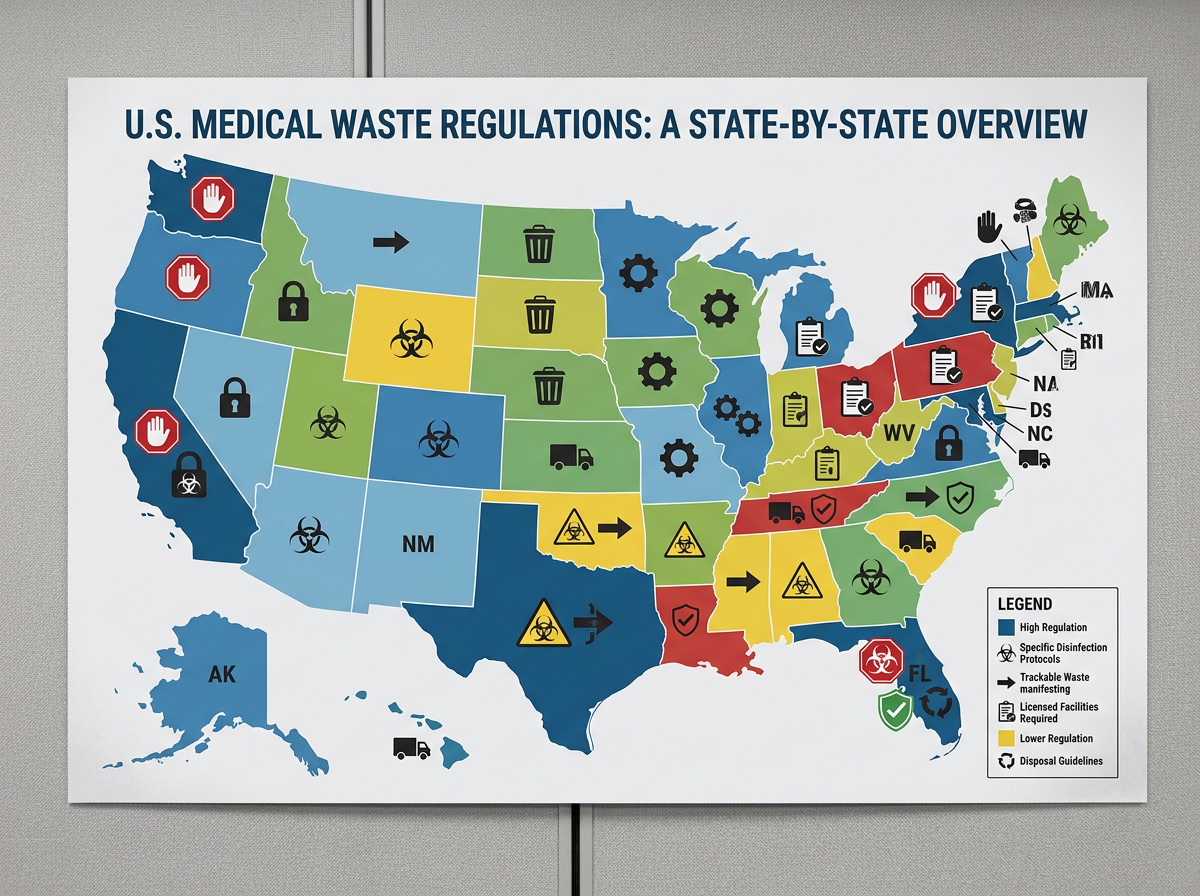
While federal guidelines provide a general framework, the true complexity of regulated medical waste management lies in the diverse and often more stringent regulations established by individual states. State Departments of Environmental Protection (DEPs) and local authorities play a pivotal role in defining RMW, often adopting unique classifications, handling requirements, and disposal protocols. These policy variations mean that healthcare facilities and waste generators must be intimately familiar with the specific rules of their operating jurisdiction. A common challenge arising from these variations is the potential for over-classification, where non-RMW is mistakenly treated as RMW, leading to significantly higher disposal costs.
New Jersey and Virginia Frameworks
New Jersey stands out with its detailed classification system, specifying seven distinct classes of regulated medical waste under N.J. Admin. Code § 7:26-3A.6(a). These are:
- Cultures and Stocks: Infectious agents and associated biologicals.
- Pathological Wastes: Human tissues, organs, body parts, and fluids.
- Human Blood and Blood Products: Bulk blood, blood components, and items saturated with blood.
- Sharps: Used or unused items capable of cutting or puncturing.
- Animal Waste: Carcasses, body parts, and bedding from animals potentially infected with human pathogens.
- Isolation Wastes: Waste from patients with highly communicable diseases.
- Unused Sharps: This class specifically addresses sharps that have not been used but are discarded, requiring RMW management due to their physical hazard.
The inclusion of “Unused Sharps” as a distinct class highlights New Jersey’s comprehensive approach.
Virginia, through its Department of Environmental Quality (DEQ), defines RMW by listing 12 specific types of solid wastes that must be managed as such. These include:
- Solid waste suspected of producing infectious disease.
- Discarded cultures, stocks, and specimens.
- Human blood and blood products.
- Pathological waste.
- Contaminated sharps.
- Animal carcasses, body parts, and bedding from animals exposed to infectious agents.
- “Category A waste,” which refers to infectious substances in a form capable of causing permanent disability, life-threatening or fatal disease in otherwise healthy humans or animals.
- Residues from spills of RMW.
Virginia’s broad definition of “solid waste suspected of producing infectious disease” and the inclusion of “Category A waste” demonstrate a robust framework for managing diverse infectious risks.
New York and Texas Frameworks
New York State employs a comprehensive regulatory framework jointly administered by the New York State Department of Environmental Conservation (NYS DEC) and the Department of Health (NYS DOH). The state typically lists five primary categories of RMW:
- Cultures and Stocks: Infectious agents and associated biologicals.
- Human Pathological Waste: Human tissues, organs, and body parts.
- Human Blood and Blood Products: Bulk blood, blood components, and items saturated with blood.
- Sharps: Needles, syringes, and other sharp objects.
- Animal Waste: Carcasses, body parts, and bedding from animals potentially infected with human pathogens.
As noted earlier, some institutions within New York, like Syracuse University, expand this list to include categories like Recombinant DNA and Select Agents, reflecting the specific needs of research environments.
Texas, under the guidance of the Department of State Health Services (DSHS) and the Texas Commission on Environmental Quality (TCEQ), identifies five categories of “special waste from health care-related facilities” that are regulated as medical waste:
- Waste from animals exposed to pathogens: Carcasses, body parts, and bedding from animals known to be infected.
- Bulk blood and bodily fluids: This category is notable for its specific bulk threshold, defining it as a containerized aggregate volume of 100 mL or more of human blood, blood products, or bodily fluids.
- Microbiological waste: Cultures, stocks, and specimens.
- Pathological waste: Human tissues, organs, and body parts.
- Sharps: Used or unused items capable of cutting or puncturing.
The explicit bulk threshold for blood and bodily fluids in Texas provides a clear quantitative measure for classification, which can differ from other states’ more qualitative definitions. These state-specific examples underscore the imperative for healthcare facilities to thoroughly understand and comply with the regulations pertinent to their geographic location.
Best Practices for Handling, Packaging, and Disposing of Regulated Waste
Proper handling, packaging, and disposal of regulated medical waste are paramount to safeguarding public health, protecting the environment, and ensuring regulatory compliance. These best practices are designed to minimize exposure to infectious agents and prevent injuries. The process typically begins at the point of generation, where waste must be immediately segregated into appropriate, compliant containers.
Key elements of best practice include:
- Segregation: Waste must be separated into RMW, hazardous chemical waste, pharmaceutical waste, and general solid waste at the point of generation. This prevents non-RMW from being improperly managed, which incurs higher disposal costs.
- Containerization: Use appropriate containers for each waste type. RMW, particularly items contaminated with blood or bodily fluids, should be placed in rigid, leak-proof containers lined with red bags bearing the universal biohazard symbol. Sharps must always go into dedicated, puncture-resistant sharps containers.
- Labeling: All RMW containers must be clearly labeled with the biohazard symbol and appropriate waste descriptions. This ensures that waste handlers are aware of the contents and potential hazards.
- Secure Closure: Containers must be securely closed once full or when ready for transport to prevent spills or leakage.
- Weight Limits: Adhere to weight limits for containers to ensure safe handling by staff and transporters.
Here is a list of essential RMW packaging steps:
- Identify: Accurately identify the waste stream at the point of generation.
- Select Container: Choose the correct container type (e.g., red bag for soft RMW, sharps container for sharps).
- Fill Appropriately: Do not overfill containers; leave enough space for secure closure.
- Seal: Securely close bags and containers using methods that prevent leakage or spillage.
- Label: Apply clear, legible labels with biohazard symbols and generator information.
- Store: Place packaged waste in designated, secure storage areas awaiting pickup.
Storage and Treatment Technologies
Once properly packaged, RMW requires specific storage and treatment protocols before final disposal.
Storage: RMW must be stored in secure, designated areas that are inaccessible to unauthorized personnel, pests, and the general public. Storage areas should be clearly marked with biohazard signs. Time limits for storage are often regulated by state law (e.g., New Jersey allows up to one year, but immediate disposal is required if waste becomes putrescent). If RMW is stored for extended periods, especially in warmer climates, refrigeration to maintain temperatures at or below 45 degrees Fahrenheit (approximately 7 degrees Celsius) may be necessary to prevent microbial growth and putrefaction.
Treatment Technologies: The primary goal of RMW treatment is to render the waste non-infectious, reducing its hazard potential before disposal. Common treatment methods include:
- Autoclaving (Steam Sterilization): This widely used method employs high-pressure steam to sterilize RMW, effectively killing microorganisms. It is particularly suitable for microbiological waste, cultures, and some sharps.
- Incineration: High-temperature incineration completely destroys RMW, reducing its volume and eliminating infectious agents. It is effective for pathological waste, sharps, and certain chemical wastes, but requires strict air pollution controls.
- Microwave Disinfection: This technology uses microwave energy to heat and sterilize RMW, often after it has been shredded or moisturized.
- Chemical Decontamination: For liquid RMW, chemical agents like bleach can be used to disinfect the waste before it is discharged into the sanitary sewer system, provided local regulations permit this.
Exclusions and Exemptions from Regulated Medical Waste
Not all waste generated in a healthcare setting is classified as RMW. Understanding these exclusions and exemptions is vital for efficient and compliant waste management.
- Hazardous Waste Exclusions: Waste classified as hazardous under RCRA (e.g., certain chemicals, pharmaceuticals) is typically managed under separate, equally stringent hazardous waste regulations, not as RMW, unless it also meets RMW criteria.
- Household Waste: Waste generated from self-care in a household setting (e.g., syringes used by a diabetic patient at home) is generally exempt from RMW regulations, although safe disposal guidelines for household sharps are often provided by local authorities.
- Incineration Ash: Ash resulting from the incineration of RMW is generally not considered RMW itself, but its disposal must comply with solid waste regulations, and it may be tested for hazardous characteristics.
- Human Remains: Human remains intended for interment (burial) or cremation are typically exempt from RMW regulations.
- Recycling Biological Materials: Under specific conditions, certain biological materials may be recycled or reused (e.g., some laboratory plastics after decontamination). However, strict protocols, often including on-site treatment and reporting, must be followed to ensure that the materials are rendered non-infectious before they re-enter the recycling stream. New Jersey’s regulations, for instance, detail conditions for recycling biological materials while maintaining RMW status post-use if not properly treated.
Frequently Asked Questions about Regulated Waste
What is the difference between regulated medical waste and general solid waste?
The fundamental difference between regulated medical waste (RMW) and general solid waste (also known as municipal solid waste or Type 10 waste) lies in its potential to transmit infectious diseases. RMW possesses an “infectious potential,” meaning it contains or is contaminated with pathogenic microorganisms that could pose a risk to human health or the environment. Because of this risk, RMW requires specialized handling, treatment (e.g., autoclaving, incineration), and disposal at licensed facilities. This specialized process makes RMW disposal significantly more expensive than general solid waste.
General solid waste, on the other hand, consists of non-infectious materials that do not pose a biological hazard. This includes typical office waste, food wrappers, uncontaminated paper, and other non-hazardous items. It can be disposed of in regular landfills, which is a much less costly process. Improper segregation, where non-infectious waste is mistakenly placed with RMW, leads to unnecessary increases in disposal costs and places an undue burden on healthcare budgets.
Why is proper waste classification critical for healthcare facilities?
Proper waste classification is critical for healthcare facilities for several compelling reasons, encompassing compliance, safety, cost efficiency, and environmental responsibility:
- Compliance: Adhering to federal, state, and local regulations is non-negotiable. Misclassification can lead to hefty fines, legal repercussions, and damage to a facility’s reputation.
- Safety: Accurate classification protects healthcare workers, waste handlers, and the public from exposure to infectious agents and physical hazards. For instance, proper sharps classification and disposal prevent needlestick injuries, which can transmit serious diseases.
- Cost Efficiency: RMW disposal is considerably more expensive than general solid waste disposal. Over-classification, where non-RMW is mistakenly treated as RMW, results in inflated operational costs. By correctly classifying waste, facilities can significantly reduce their disposal expenses.
- Environmental Impact: Proper classification ensures that waste is treated and disposed of in an environmentally sound manner, preventing the release of pathogens or hazardous substances into the ecosystem.
Precise classification is an investment in safety, financial prudence, and environmental stewardship.
How do state regulations differ from federal EPA guidelines?
State regulations for regulated medical waste often differ significantly from federal EPA guidelines, typically by being more specific and, in many cases, more stringent. Here’s how they generally diverge:
- Baseline vs. Specificity: Federal agencies like the EPA and OSHA provide overarching guidelines and standards (e.g., defining broad categories of RMW or setting worker safety protocols). States, through their Departments of Environmental Protection (DEPs) or Health Departments, then develop detailed regulations that implement or expand upon these federal baselines.
- Stricter Definitions and Classes: States frequently adopt stricter definitions for what constitutes RMW and may establish a greater number of distinct waste classes or categories than the federal framework. For example, while the EPA identifies several types of RMW, New Jersey explicitly lists seven classes, and Virginia identifies 12 specific types of solid waste to be managed as RMW. These state-specific classes often include unique items or thresholds (like Texas’s bulk threshold for blood).
- Local Enforcement and Permitting: State agencies are primarily responsible for issuing permits for RMW generators, transporters, and treatment facilities. They also handle the day-to-day enforcement of regulations, conduct inspections, and manage state-specific tracking forms and reporting requirements.
- Policy Variations: States can introduce unique policy variations based on local environmental concerns, population density, or specific industry needs. This leads to a patchwork of regulations across the country, requiring facilities to consult their specific state and local authorities for accurate compliance information.
This decentralized regulatory landscape means that while federal guidelines provide a common language, the operational specifics of RMW management are largely dictated by state and local authorities.
Conclusion
The journey through the intricate world of regulated medical waste classifications reveals a landscape shaped by federal baselines and diverse state-specific mandates. From the six broad categories recognized at the federal level to the nuanced seven classes in New Jersey, or the 12 specific types in Virginia, understanding “how many regulated medical waste classes” exist is not about a single number, but rather a commitment to jurisdictional specificity.
Effective waste management is a cornerstone of sustainable solutions in healthcare and research. It demands meticulous attention to detail, from the initial act of waste segregation at the point of generation to its final treatment and disposal. Adhering to best practices in handling, packaging, storage, and utilizing appropriate treatment technologies is crucial. Equally important is the ability to distinguish RMW from general solid waste and to recognize exclusions and exemptions, preventing costly over-classification.
A comprehensive understanding of these classifications and the regulatory frameworks governing them ensures compliance, protects the safety of healthcare personnel and the public, minimizes environmental impact, and fosters operational efficiency. As the medical and scientific fields continue to evolve, so too will the challenges and solutions in regulated waste management, necessitating ongoing vigilance and expertise in this critical domain.