

Where Innovation Meets Opportunity: The Rise of Modern Office Spaces in 2026

Table of Contents
- 1 The Evolution of Corporate Environments in 2026
- 2 Optimizing Business Operations Through Strategic Site Selection
- 3 Analyzing the Pittsburgh Submarket Landscape
- 4 Lease Renewal vs. Relocation: A Strategic Framework
- 5 The Role of Conflict-Free Representation in Corporate Strategy
- 6 Frequently Asked Questions About Pittsburgh Office Leasing
- 7 Finalizing Your 2026 Real Estate Strategy
The Evolution of Corporate Environments in 2026
 In today’s business world, strategic growth is key. Companies must adapt quickly to market changes. We see this especially in real estate decisions. The right office space can power your business forward. It can also shape your brand and attract top talent.
Our focus today is on how real estate choices impact strategic growth. We will explore the vibrant office market in Pittsburgh, Pennsylvania. Specifically, we will look at the Strip District. This area has become a hub for innovation and business. For businesses seeking prime locations, understanding Strip District office space for operations here is crucial.
This extensive guide will show you why the Strip District is a prime location. We will cover market trends and available spaces. We will also discuss lease rates and key properties for April 2026. Understanding these factors is vital for any business looking to thrive.

The corporate landscape in April 2026 is a dynamic tapestry woven with threads of innovation, flexibility, and a renewed focus on employee well-being. The traditional office, once a static entity, has evolved into a strategic asset designed to foster collaboration, ignite creativity, and support diverse work models. Pittsburgh, with its rich industrial heritage and burgeoning tech sector, mirrors this national trend. We’ve witnessed a significant urban migration, as businesses gravitate towards vibrant, amenity-rich neighborhoods that offer a compelling “live-work-play” environment. This shift is not merely about aesthetics; it’s a calculated move to enhance workplace culture and, critically, to attract and retain top-tier talent.
Companies are increasingly recognizing that their physical space is a powerful tool in their recruitment and retention strategies. A well-designed office, situated in an engaging locale, communicates a company’s values and commitment to its employees. It’s no longer enough to simply provide a desk; the modern workforce seeks environments that inspire, connect, and offer convenience. This is particularly evident in the competitive Pittsburgh market, where the battle for skilled professionals is intensifying.
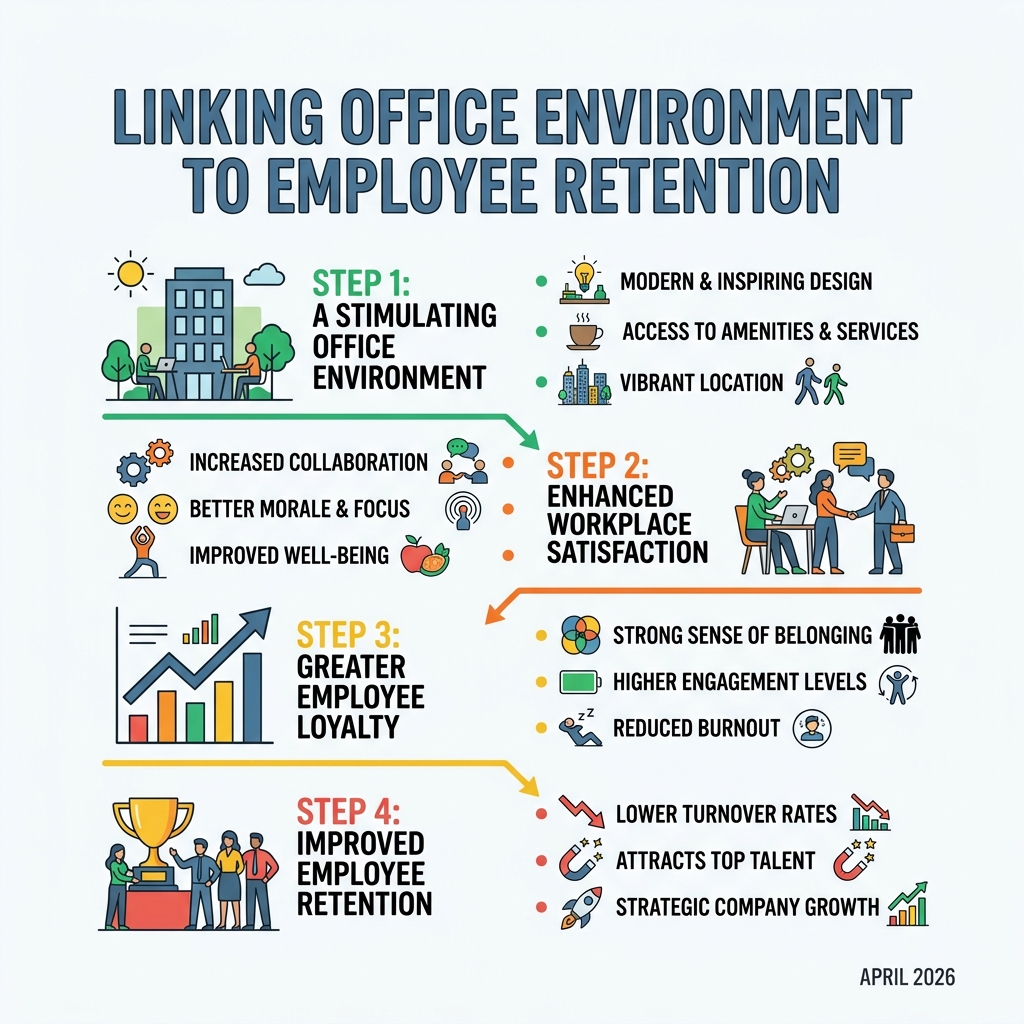
The link between a stimulating office environment and employee retention is undeniable. Spaces that promote health, offer flexibility, and are embedded within lively communities contribute significantly to job satisfaction and loyalty. As we navigate 2026, the emphasis is firmly on creating workplaces that are not just functional, but truly transformative.
Optimizing Business Operations Through Strategic Site Selection
Strategic site selection is paramount for optimizing business operations. It’s a decision that impacts everything from logistics and talent acquisition to infrastructure and workflow efficiency. In Pittsburgh, the Strip District stands out as a prime example of a location that offers a competitive edge. Its unique blend of historic charm and modern development creates an attractive proposition for businesses across various sectors.
When evaluating a location, we consider several critical factors. Proximity to key transportation arteries, access to a skilled labor pool, and the availability of robust infrastructure are fundamental. The Strip District excels in these areas, boasting excellent connectivity and a demographic profile that is highly appealing to employers. With an average household income of $133,000 and an impressive 87% of residents holding Bachelor’s Degrees, the talent pool here is both affluent and highly educated. This concentration of skilled individuals makes recruitment significantly easier and more efficient. Furthermore, the area’s average home value of $470,000 indicates a desirable residential environment, further cementing its appeal for employees seeking a high quality of life.
The strategic choice of a location like the Strip District goes beyond mere square footage; it’s about embedding your operations within an ecosystem that supports growth and innovation. Whether you’re a startup or an established enterprise, understanding the nuances of Pittsburgh’s commercial real estate, including specific office space solutions, is essential.
Aligning Physical Space with Modern Business Operations
The physical configuration of an office space must seamlessly align with modern business operations, particularly in an era dominated by hybrid work models. Companies in 2026 are seeking spatial designs that can adapt to fluctuating team sizes, support both in-person collaboration and remote connectivity, and integrate cutting-edge technology. This means moving beyond rigid cubicle farms to embrace flexible layouts, collaborative zones, quiet focus areas, and advanced conferencing capabilities.
Progressive workplace design, as exemplified by projects like The Vision on Fifteenth, emphasizes open, adaptable spaces that can be reconfigured to suit various tasks and team dynamics. Technology integration is key, ensuring seamless digital workflows whether employees are on-site or working remotely. We’re seeing a push for smart buildings that optimize energy use, enhance air quality, and provide intuitive control over environmental factors, all contributing to improved productivity metrics and employee satisfaction. Even in the realm of coworking, spaces like the modern facilities found in LoHi in Denver, CO, illustrate how thoughtful design can create a vibrant, productive environment, a trend we also observe in Pittsburgh’s evolving office market.
Mitigating Risks in Daily Business Operations
Mitigating risks in daily business operations through strategic real estate decisions involves foresight and careful planning. Lease flexibility and scalability are paramount in a rapidly changing economic climate. Businesses need the option to expand or contract their footprint without incurring prohibitive penalties, allowing them to respond nimbly to market shifts. This often means exploring different lease terms, options for expansion, or even the possibility of subleasing parts of their space if conditions change.
Operational overhead, including utility costs and maintenance, must be carefully managed. Modern buildings in the Strip District often come equipped with advanced systems, such as 3-phase electrical and substantial HVAC capacity, which contribute to greater energy efficiency and reduced operational costs in the long run. Furthermore, considerations like utility redundancy and robust IT infrastructure are critical for business continuity, minimizing downtime and protecting against unforeseen disruptions. By choosing well-maintained, technologically advanced office spaces, businesses can significantly reduce their exposure to operational risks and ensure a smoother, more resilient daily workflow.
Analyzing the Pittsburgh Submarket Landscape
The Pittsburgh office market in April 2026 presents a diverse landscape, with distinct characteristics defining its various submarkets. Understanding these differences is crucial for any business contemplating a move or expansion within the city. The total office space across Pittsburgh’s significant buildings (those over 50,000 square feet) stands at approximately 2,515,957 square feet. This inventory is segmented by class, reflecting varying levels of amenities, age, and location desirability.
Currently, Class A properties account for about 1,110,364 square feet, representing 44.13% of the total market. Class B spaces, which offer a solid balance of quality and value, comprise the largest share at 1,331,240 square feet, or 52.91%. Class C properties make up the remaining 2.96% with 74,353 square feet. When we look at building sizes, the market is dominated by mid-to-large properties, with buildings between 100,000 and 500,000 square feet accounting for a substantial 81.76% of the total inventory.
While specific vacancy rates for April 2026 vary by submarket and class, areas like the Strip District continue to demonstrate strong demand, often leading to lower vacancy rates for premium spaces. For a deeper dive into the specific dynamics of different areas, exploring current Pittsburgh vacancy rates can provide valuable insights into hot spots and areas with more availability.
The Strip District as a Live-Work-Play Hub
The Strip District has undergone a remarkable transformation, evolving from its industrial roots into a vibrant live-work-play destination. This evolution has made it one of Pittsburgh’s most sought-after locations for office space, particularly for companies seeking a dynamic urban environment. The neighborhood’s appeal is multifaceted, combining historic charm with cutting-edge development.
Key properties exemplify this trend. The Vision on Fifteenth, completed in 2021, is a prominent 265,000 square foot mixed-use project that anchors the Strip District’s entrance. It offers significant office availability, ranging from 5,484 to 140,638 square feet, characterized by progressive workplace design and expansive views of the city and the Allegheny River. Another significant development is 75 Hopper Place, a 145,292 square foot office building also completed in 2021, with up to 40,055 square feet available at competitive rates. Even larger, 1520 Smallman Street represents a massive 558,369 square foot building, offering substantial contiguous space for large-scale operations.
This area has become a recognized tech corridor, attracting innovative companies drawn by the neighborhood’s energy and its proximity to educational institutions. The adaptive reuse of historic industrial buildings, such as The Cigar Factory (an 1895 building now offering modern office spaces), showcases the Strip District’s commitment to historic preservation while embracing contemporary needs. This blend of old and new, coupled with a bustling array of restaurants, shops, and residential options, creates an unparalleled environment for businesses and their employees.
Emerging Opportunities in the East End and North Shore
While the Strip District shines, other Pittsburgh submarkets are also presenting compelling opportunities for businesses in April 2026. The East End, encompassing areas like East Liberty, Shadyside, and Oakland, continues to be a hub for innovation, education, and healthcare. Oakland, in particular, benefits from its institutional proximity to major universities and medical centers, making it ideal for life sciences, research, and technology firms that thrive on collaboration with academic and medical communities. East Liberty has seen significant revitalization, attracting tech companies and offering a vibrant urban experience with diverse retail and dining.
The North Shore, situated across the Allegheny River from Downtown, offers a distinct advantage with its stunning riverfront views, proximity to sports venues, and growing residential options. This area appeals to businesses looking for modern office spaces with easy access to Downtown amenities without the immediate hustle and bustle of the central business district. Both the East End and North Shore are characterized by ongoing development, modern infrastructure, and a strong talent pool, offering attractive alternatives or complementary locations for businesses considering their strategic real estate footprint in Pittsburgh.
Lease Renewal vs. Relocation: A Strategic Framework
The decision between renewing an existing office lease and relocating to a new space is one of the most critical strategic choices a business can make. This isn’t merely a logistical exercise; it’s a financial and operational imperative that can significantly impact a company’s future. As of April 2026, market conditions, influenced by factors like inventory levels and demand, play a pivotal role. Leveraging current CoStar statistics and a deep understanding of the market can provide invaluable insights into rental growth, vacancy rates, and tenant improvement allowances.
Market competition directly influences a tenant’s leverage during negotiations. In a landlord-favorable market, securing advantageous terms for a renewal can be challenging. Conversely, a tenant-favorable market might make relocation to a superior space more economically viable. Beyond financial considerations, businesses must weigh build-out timelines and capital expenditures. Renovating an existing space can be less disruptive but might not address fundamental layout or infrastructure deficiencies. A new build-out, while potentially more costly and time-consuming, offers the opportunity to create a space perfectly tailored to current and future needs. For insights into how other companies have navigated these complex decisions, exploring various case studies can offer practical lessons and strategic approaches.
Financial Implications of Staying Put
Opting for a lease renewal often seems like the path of least resistance, but it comes with its own set of financial implications that require careful scrutiny. The base rent is just the starting point; businesses must also account for escalation clauses, which can steadily increase rental costs over the lease term. Operating expenses, or “opes,” which include property taxes, insurance, and common area maintenance, are another significant variable, often subject to annual adjustments.
A critical component of any renewal negotiation is the tenant improvement (TI) allowance. While landlords may offer TIs for a renewal, they are often less generous than those offered for new leases, as the landlord faces less competition for an existing tenant. Businesses must assess whether the offered TI is sufficient to cover necessary upgrades or repairs to keep the space functional and appealing. Without a thorough understanding of current market rates and comparable deals, a business might inadvertently agree to terms that are above market, missing out on potential savings or better value elsewhere.
The Case for Relocating to Class A Space
Relocating to Class A space can be a powerful strategic move, particularly for companies focused on growth, talent attraction, and brand positioning. The demand for Class A properties in desirable submarkets like the Strip District remains consistently strong in April 2026, driven by businesses seeking modern amenities, superior infrastructure, and a prestigious address.
Class A spaces typically offer state-of-the-art building systems, enhanced energy efficiency, and a higher level of finishes, all of which contribute to a more comfortable and productive work environment. These buildings often boast amenities such as fitness centers, cafes, collaborative lounges, and advanced security, which are increasingly important for employee recruitment and retention. From a brand perspective, a Class A location can significantly elevate a company’s image, signaling success and stability to clients, partners, and prospective employees. Understanding the nuances between different property classifications is crucial, and a detailed examination of Class A vs Class B office space can help businesses make an informed decision about the best fit for their needs.
The Role of Conflict-Free Representation in Corporate Strategy
In the complex world of commercial real estate, the role of conflict-free representation in corporate strategy cannot be overstated. When businesses engage a tenant representative who exclusively serves their interests, they gain a powerful advocate in negotiations. This model ensures a fiduciary duty solely to the tenant, fostering market transparency and maximizing negotiation leverage. Unlike traditional brokerages that may represent both landlords and tenants, a conflict-free advisor eliminates the inherent ethical dilemmas, guaranteeing that every recommendation and strategy is aligned with the tenant’s best outcome.
Proprietary technology platforms, such as the “Ghost” platform mentioned in our research, further enhance this advantage by providing tenants with unprecedented access to market data, comparables, and negotiation insights. This data-driven approach empowers businesses to make informed decisions, secure favorable lease terms, and avoid common pitfalls. For any business navigating the nuances of the commercial real estate market, particularly when it comes to securing optimal terms for their commercial tenant representation, choosing an exclusive tenant representative is a strategic imperative.
Eliminating Dual Agency Conflicts
The concept of dual agency, where a single brokerage represents both the landlord and the tenant in a transaction, creates an undeniable conflict of interest. While some jurisdictions permit it with disclosure, it inherently compromises the tenant’s position. The landlord’s primary interest is to maximize rental income and secure favorable lease terms for their property. A broker representing both parties cannot truly provide unbiased advice or aggressively negotiate against one party’s interests for the benefit of the other.
Conflict-free representation completely eliminates this dilemma. An exclusive tenant representative is legally and ethically bound to act solely in the tenant’s best interest. This means they will actively seek out the best available options across the entire market, negotiate the lowest possible rent, secure the most generous tenant improvement allowances, and advocate for favorable lease clauses. They leverage market competition and proprietary data to create an environment where the tenant has maximum bargaining power, ensuring that the deal truly reflects the tenant’s needs and objectives, not the landlord’s.
Strategic Advisory and Long-Term Value
Beyond the immediate transaction, an exclusive tenant representative provides strategic advisory that delivers long-term value to a business. This goes beyond just finding space; it encompasses a holistic approach to real estate portfolio management. Advisors assist with rightsizing strategies, ensuring that a company’s footprint remains aligned with its evolving operational needs, whether that means expansion, contraction, or adapting to hybrid work models.
They conduct thorough lease audits, scrutinizing existing agreements for hidden costs, unfavorable clauses, or opportunities for renegotiation. This proactive approach helps businesses avoid costly mistakes and ensures their real estate strategy supports their overarching corporate goals. From initial site selection to lease renewal or disposition, having an expert in your corner who offers impartial advice and an independent perspective is invaluable. We encourage businesses to regularly schedule a lease review to ensure their real estate strategy remains optimized and cost-effective.
Frequently Asked Questions About Pittsburgh Office Leasing
What is the current availability of Class A space in the Strip District?
As of April 2026, the Strip District remains a primary target for Class A seekers. While inventory can fluctuate, major projects like The Vision on Fifteenth continue to offer significant contiguous blocks of premium space, ranging from several thousand square feet up to over 100,000 square feet. The total Pittsburgh Class A inventory sits at approximately 1,110,364 square feet, with the Strip District commanding premium rates due to its high concentration of new builds, meticulously converted lofts, and modern amenities. Current listings indicate around 39 office spaces available for rent in the Strip District, many of which are Class A or high-quality Class B properties.
How do 2026 lease rates in the Strip District compare to Downtown?
Strip District rates for premium Class A space currently range from approximately $34.00 to $38.75 per square foot annually. While this often exceeds traditional Central Business District averages, the value proposition in the Strip District is compelling. The higher rates reflect the neighborhood’s vibrant amenities, modern infrastructure, and the highly desirable “live-work-play” environment. This area also boasts a high percentage of residents with advanced degrees (87% with Bachelor’s Degrees), which significantly supports talent recruitment efforts, making the investment in a Strip District location a strategic choice for many forward-thinking businesses.
Why should a business use a tenant-only representative?
A business should use a tenant-only representative to ensure their interests are exclusively prioritized throughout the commercial real estate process. This approach avoids the inherent conflict of interest found in traditional brokerages that also represent landlords. With a tenant-only representative, you gain 100% loyalty and unbiased advice, ensuring that every negotiation tactic, market analysis, and property recommendation is solely aimed at securing the best possible outcome for your business. This often translates to securing more favorable lease terms, higher tenant improvement allowances, flexible exit strategies, and access to a broader range of options, all without the pressure to fill a specific landlord’s vacancy.
Finalizing Your 2026 Real Estate Strategy
As businesses look to the future, finalizing a robust real estate strategy for 2026 demands careful consideration of market dynamics, operational needs, and long-term growth objectives. The Pittsburgh market, particularly the dynamic Strip District, offers a wealth of opportunities for companies seeking to optimize their physical footprint and enhance their competitive edge. Strategic planning, informed by expert market timing and meticulous execution, is paramount to securing the right space at the right terms.
Whether you are contemplating a new lease, a renewal, or a relocation, the decisions you make today will significantly shape your business’s trajectory for years to come. We believe in empowering businesses with the insights and representation necessary to navigate this complex landscape with confidence. To ensure your real estate strategy is not just effective but truly transformative, we invite you to contact Donahue Advisors for a comprehensive lease strategy session. Our expertise is dedicated to aligning your physical space with your strategic ambitions.