
Being partially at fault for an accident does not automatically mean you cannot recover compensation for your injuries or property damage. In many situations, responsibility is divided among the people or businesses involved. The practical effect depends on the evidence, the available insurance coverage, and the law of the state where the crash occurred. For people sorting through these questions after a collision, Quinn Law Group can be a starting point for understanding the issues that may affect an accident claim. Fault can be shared in many ways. A driver may have been speeding while another driver made an unsafe turn. A pedestrian may have crossed outside a crosswalk while a driver was distracted. Even when you made a mistake, another party may still bear a meaningful share of responsibility for causing the harm.
Table of Contents
What Partial Fault Means
Partial fault means that your conduct may have contributed to an accident or made the resulting injuries worse. It is a civil liability issue, not necessarily a final judgment about who caused the crash. For example, a driver who was following too closely may share fault with a driver who suddenly changed lanes without signaling. Fault is usually expressed as a percentage. One person might be found 20 percent responsible, while another is found 80 percent responsible. The percentage can be negotiated during an insurance claim or decided by a judge or jury if the dispute reaches court.
How State Fault Rules Affect Compensation
States do not all handle shared responsibility the same way. The legal concept of comparative negligence generally allows an injured person to seek damages reduced by their own percentage of fault. Still, the exact rule, including the percentage at which recovery may be barred, depends on state law.
Pure Comparative Negligence
Under a pure comparative negligence system, an injured person can generally recover the portion of damages caused by others, even if that person was mostly at fault. If total losses are $100,000 and the injured person is 70 percent at fault, recovery could be limited to $30,000.
Modified Comparative Negligence
Many states use a modified system. Depending on the state, a person may be unable to recover if they are 50 percent, 51 percent, or more responsible for the accident. The difference between being assigned 49 percent and 50 percent fault can therefore be significant.
Contributory Negligence
A small number of jurisdictions follow a stricter approach called contributory negligence. Under that approach, even a small degree of fault may prevent an injured person from recovering damages from another negligent party. Because the governing rule can dramatically affect a claim, state-specific advice is important.
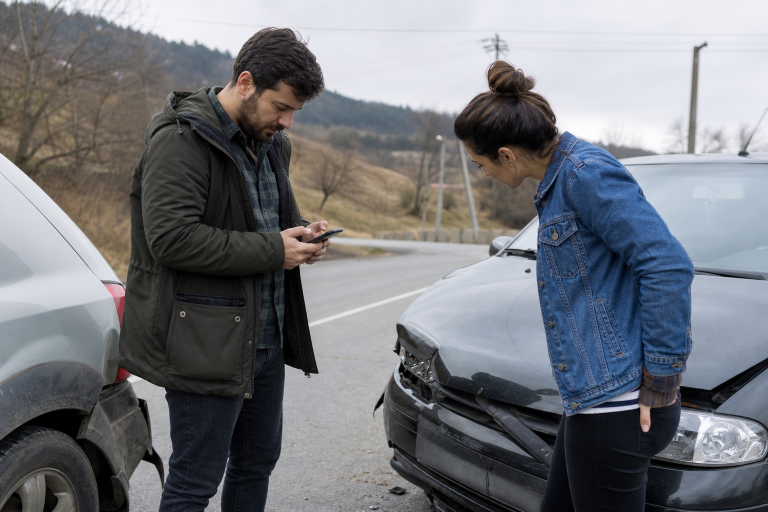
When comparative fault applies, the total value of proven damages is generally reduced by the injured person’s percentage of responsibility. Damages may include medical bills, lost income, vehicle repairs, pain and suffering, rehabilitation costs, and other accident-related losses. Consider a collision in which a driver incurs $50,000 in total losses but is found 25 percent responsible for speeding. If the other driver is 75 percent responsible for failing to yield, the potential recovery may be reduced by 25 percent, leaving $37,500 before other claim issues are considered. Partial fault may also affect claims involving multiple vehicles, commercial drivers, employers, defective vehicle parts, unsafe property conditions, cyclists, or pedestrians. In those cases, several parties may share responsibility, and the rules for allocating payment can become more complicated.
Evidence Used To Assign Fault
Fault should be based on facts, not assumptions made during a stressful roadside conversation. Insurers and legal professionals may review a range of evidence, including:
- Police reports and traffic citations.
- Photographs of vehicle damage, road markings, debris, and traffic signals.
- Witness names, statements, and video footage.
- Medical records showing the nature and timing of injuries.
- Phone records or other evidence of distraction, when legally available.
- Dashcam footage, security-camera footage, and vehicle inspection findings.
Some vehicles also contain technology that records limited information shortly before, during, or after a crash. An event data recorder may preserve details such as speed, braking, seat belt use, or airbag deployment, although the information available varies by vehicle and circumstance.
Dealing With Insurance Companies
You should promptly report an accident to your own insurer under the terms of your policy. Provide accurate basic information, keep the claim number, and save all emails, letters, estimates, and notes from phone calls. Reporting a crash is different from agreeing with an adjuster’s assessment of fault. Be cautious about making broad statements such as “It was all my fault” before the facts are known. An apology, a traffic ticket, or a belief that you could have reacted differently does not always establish complete legal responsibility. Stick to what you personally saw, heard, and did. Before accepting a settlement or signing a release, make sure you understand what claims and future expenses may be included. A quick payment may not account for later treatment, time away from work, or a dispute over the percentage of fault assigned to you.
- Get to a safe location and call 911 when injuries, hazards, or significant damage are involved.
- Seek medical care promptly, including follow-up care for symptoms that appear later.
- Exchange identification, insurance, vehicle, and contact information without arguing about blame.
- Take photos and videos if it is safe to do so.
- Get witness contact details before witnesses leave.
- Preserve damaged property, dashcam files, repair estimates, receipts, and medical records.
- Avoid posting about the accident or your injuries on social media.
When Legal Guidance May Be Helpful
Not every accident requires legal assistance. However, it may be useful to discuss your situation with a qualified professional when injuries are serious, fault is disputed, several parties are involved, a commercial vehicle is involved, insurance coverage is limited, or an insurer denies or undervalues the claim. Being partially at fault does not end the analysis. The important questions are how the accident happened, what evidence supports each version of events, which state law applies, and how much of the loss is connected to each party’s conduct. Acting carefully, documenting the facts, and understanding the applicable fault rules can make the next steps more manageable.
Conclusion
Being partly responsible for an accident does not necessarily mean you lose your right to compensation. The outcome depends on the evidence, the percentage of fault assigned to each party, insurance coverage, and the state’s negligence rules. After a crash, focus on getting medical care, documenting what happened, preserving evidence, and avoiding assumptions about responsibility before all the facts are reviewed. When injuries are serious or fault is disputed, speaking with a qualified legal professional can help you understand your options and how shared fault may affect your potential recovery.