
How Cooling Towers Power America’s Data Centers, Hospitals, and HVAC Companies

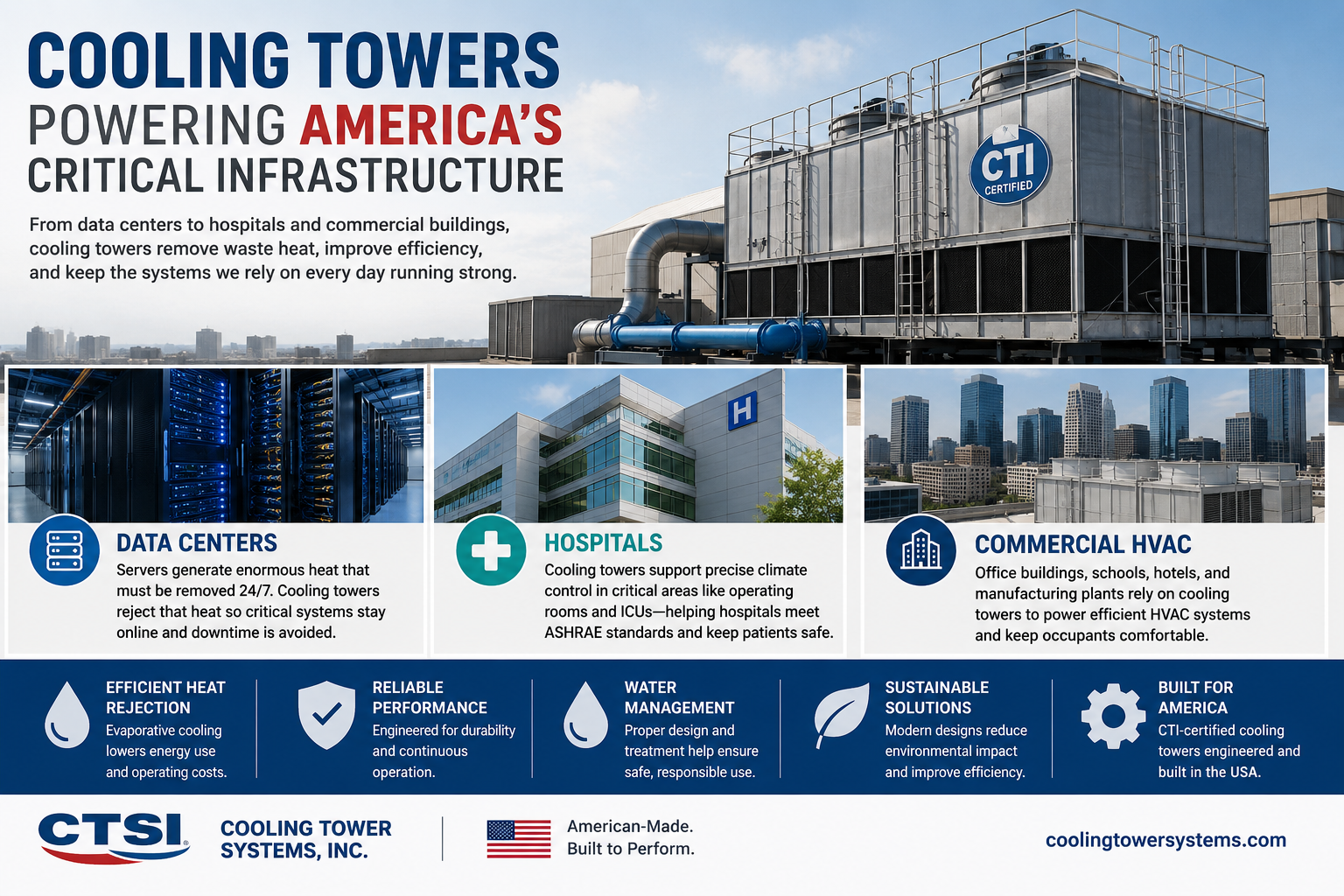
Across America, the buildings and facilities we depend on every day rely on a piece of infrastructure most people never see: the cooling tower. From the data centers that power streaming, search, and AI to the hospitals that keep patients safe and the office buildings that keep workers comfortable, cooling towers quietly do the heavy lifting of removing waste heat from critical systems. As demand for computing power, healthcare capacity, and energy-efficient buildings grows, the role of cooling towers in American infrastructure has never been more important.
This article looks at three of the largest sectors that depend on cooling towers, why these systems matter, and how they support the everyday operations of facilities across the country.
Table of Contents
- 1 What Is a Cooling Tower and Why Does It Matter?
- 2 Cooling Towers in America’s Data Centers
- 3 Cooling Towers in Hospitals and Healthcare Facilities
- 4 Cooling Towers and the American HVAC Industry
- 5 Looking Ahead: Cooling Towers and the Future of U.S. Infrastructure
- 6 Need a Cooling Tower for Your Facility?
- 7 Frequently Asked Questions
What Is a Cooling Tower and Why Does It Matter?
A cooling tower is a heat-rejection device. It removes waste heat from a building or industrial process by transferring it from circulating water into the atmosphere, usually through evaporation. Warm water from a chiller, condenser, or piece of equipment is pumped into the tower, distributed across fill media, and exposed to airflow. A small portion of the water evaporates, which cools the rest. The cooled water is then sent back into the system to absorb more heat, and the cycle continues.
Without cooling towers, the equipment behind the digital and physical infrastructure of modern life would overheat within hours. Servers would shut down, hospitals would lose climate control in critical patient areas, and large commercial HVAC systems would fail. Cooling towers are the unsung backbone of facility operations across the United States.
Cooling Towers in America’s Data Centers
The United States is home to more than 5,400 data centers, more than any other country in the world. These facilities house the servers that process everything from cloud storage and email to artificial intelligence workloads. The catch is that all of that processing generates an enormous amount of heat, and managing that heat is one of the single biggest operational challenges in the industry.
According to the Environmental and Energy Study Institute, a medium-sized data center can consume up to 110 million gallons of water per year for cooling, and the largest hyperscale facilities can use as much as 5 million gallons per day. The Lawrence Berkeley National Laboratory has reported that U.S. data centers consumed roughly 17 billion gallons of water for cooling in 2023, with projections that the figure could double or even quadruple by 2028 as AI workloads accelerate.
Most of that cooling happens through evaporative systems where cooling towers play a central role. Hot air from servers transfers heat to a water loop, which is then sent to a cooling tower to release that heat into the atmosphere. For data centers handling AI training, this cycle runs continuously, and any failure in the cooling system can cause overheating, hardware damage, or expensive downtime.
Why Closed-Circuit Designs Are Gaining Ground
Many newer data center designs are turning to closed-circuit cooling towers, which keep the process fluid sealed inside coils while a secondary water loop sprays over the outside of the coils to provide evaporative cooling. This design protects sensitive equipment from contamination, reduces fouling, and is well suited to the clean-water demands of modern computing infrastructure. Microsoft, for example, has committed to deploying closed-loop cooling at facilities like its Mt. Pleasant, Wisconsin site as part of a broader push to be water-positive by 2030.
Cooling Towers in Hospitals and Healthcare Facilities
Few buildings have more demanding climate control needs than hospitals. Operating rooms, isolation wards, pharmacy compounding suites, and intensive care units all require precisely controlled temperature, humidity, and air pressure. Cooling towers provide the heat rejection capacity that allows hospital chillers and HVAC systems to maintain those tightly regulated environments around the clock.
The American Society of Heating, Refrigerating and Air-Conditioning Engineers (ASHRAE) publishes Standard 170, which sets minimum ventilation parameters for healthcare facilities, including operating rooms, airborne infection isolation rooms, and protective environment rooms. Meeting those standards depends on consistent, reliable cooling capacity, and that cooling capacity depends on properly sized and maintained cooling towers.
Hospital cooling systems also have to be exceptionally well maintained. Poorly maintained cooling towers can become breeding grounds for waterborne bacteria, including Legionella, which causes Legionnaires’ disease. The Centers for Disease Control and Prevention recommends that healthcare facilities implement water management programs to identify hazards, control growth, and routinely monitor performance. Proper tower design, regular cleaning, and consistent water treatment are non-negotiable in hospital settings.
Cooling Towers and the American HVAC Industry
The third sector where cooling towers do massive lifting is commercial HVAC. Office buildings, hotels, schools, shopping centers, manufacturing plants, and large institutional campuses all rely on chilled-water HVAC systems for comfort cooling, and almost every one of those systems uses a cooling tower to reject heat.
In a typical commercial building, warm condenser water leaves the chiller at around 95 degrees Fahrenheit, flows to the cooling tower, and returns at around 85 degrees Fahrenheit. That ten-degree drop is what allows the chiller to keep producing chilled water for the air handlers that cool the building. Without a properly sized and well-maintained cooling tower, the entire HVAC system starts to lose efficiency, energy bills climb, and occupant comfort suffers.
HVAC contractors and engineers across the U.S. specify cooling towers based on a range of factors, including local wet-bulb temperature, building cooling load, available footprint, and water quality. The right tower design, whether crossflow or counterflow, induced or forced draft, open or closed loop, makes a measurable difference in long-term operating cost, water consumption, and reliability.
Looking Ahead: Cooling Towers and the Future of U.S. Infrastructure
As America builds out more data centers, expands hospital capacity, and pushes for more energy-efficient commercial buildings, demand for high-performing cooling towers will only grow. At the same time, water scarcity, environmental regulation, and energy efficiency standards are pushing the industry toward smarter designs, like hybrid wet-dry systems, closed-circuit configurations, and CTI-certified equipment that delivers verified thermal performance.
For facility managers, engineers, and building owners across the country, understanding how cooling towers work and where they fit into the bigger picture is the first step toward making smarter infrastructure decisions, both today and over the next decade.
Need a Cooling Tower for Your Facility?
Cooling Tower Systems, Inc. has been manufacturing reliable, American-made cooling towers for over 30 years. Headquartered in Georgia and serving facilities across the United States, CTS designs and builds open-loop, closed-circuit, and CTI-certified cooling towers for data centers, hospitals, manufacturing plants, and commercial HVAC systems. To learn more or request a quote tailored to your application, visit Cooling Tower Systems.
Frequently Asked Questions
Q: How does a cooling tower work in a data center?
A: In a data center, a cooling tower removes waste heat generated by servers. Hot air from the server racks transfers heat to a water loop, and that warm water is sent to the cooling tower, where a portion evaporates to cool the rest. The cooled water then returns to the system to absorb more heat. This continuous cycle keeps servers operating within safe temperature ranges.
Q: Do hospitals use cooling towers?
A: Yes. Hospitals rely on cooling towers to support their HVAC and chiller systems, which maintain precise temperature, humidity, and air-pressure conditions in operating rooms, ICUs, isolation rooms, and other clinical areas. Proper tower maintenance is essential because poorly maintained units can harbor bacteria like Legionella.
Q: What is the difference between an open-circuit and a closed-circuit cooling tower?
A: Open-circuit (or open-loop) cooling towers expose the process water directly to air, cooling it through evaporation. Closed-circuit cooling towers keep the process fluid sealed inside coils, with a separate spray water loop providing evaporative cooling on the outside. Closed-circuit designs prevent contamination and are common in data centers, food processing, and clean industrial applications.
Q: How much water does a cooling tower use?
A: Water consumption depends on the size of the tower, the heat load, and local climate. A medium-sized data center cooling system may consume around 110 million gallons of water per year, while smaller commercial HVAC towers use far less. Proper water treatment, drift eliminators, and efficient design help reduce consumption.
Q: What is CTI certification for cooling towers?
A: CTI (Cooling Technology Institute) certification verifies that a cooling tower has been independently tested and proven to meet its published thermal performance ratings. Buyers and engineers use CTI certification to confirm that a tower will deliver the cooling capacity stated on its spec sheet, which is critical for sizing systems correctly.
Q: How long does a cooling tower last?
A: With proper maintenance, a well-built cooling tower can last 20 years or more. Lifespan depends on materials of construction (FRP, galvanized steel, or stainless steel), water quality, climate, and how rigorously the unit is cleaned and serviced. Regular inspections and replacement of wear parts like fan belts, fill media, and float valves significantly extend service life.