

Managing Environmental Risks in Commercial Construction
Table of Contents
The Role of Environmental Consulting and Safety in Site Acquisition
Investing in commercial construction projects is a significant undertaking. However, hidden environmental risks can quickly turn a promising venture into a costly liability. Imagine acquiring a property, only to discover years of unknown contamination. Such findings can cause major delays, unexpected expenses, and severe legal challenges.
To protect your investment and ensure project success, understanding a property’s environmental history is crucial. This is where a Phase I Environmental Site Assessment (ESA) plays a vital role. It serves as an early warning system, helping to identify potential environmental concerns before they become major problems.
In this extensive guide, we will explore everything you need to know about Phase I ESAs. We’ll clarify who is qualified to perform these critical assessments and why their expertise is essential. We will also detail the assessment process and explain why thorough environmental due diligence is a cornerstone of responsible commercial construction. For expert guidance in navigating these complex environmental matters, specialized firms like Omega Environmental Consulting offer valuable services. Our aim is to equip you with the knowledge to manage environmental risks effectively, safeguarding your projects from start to finish.
The acquisition of commercial property is a complex process, often involving significant financial investment and legal considerations. Before any ground is broken or financing secured, a Phase I Environmental Site Assessment (ESA) stands as a foundational step. This initial assessment is designed to identify potential environmental liabilities associated with a property, primarily focusing on the presence or likely presence of hazardous substances or petroleum products.
A Phase I ESA is not merely a formality; it is a critical tool for risk management and liability protection. It adheres to stringent industry standards, most notably ASTM E1527-21, which outlines the “Standard Practice for Environmental Site Assessments: Phase I Environmental Site Assessment Process.” This standard is recognized by the U.S. Environmental Protection Agency (EPA) as complying with the “All Appropriate Inquiries” (AAI) rule. Conducting an ESA in accordance with AAI is vital for prospective property owners seeking certain liability protections under the Comprehensive Environmental Response, Compensation, and Liability Act (CERCLA), often referred to as Superfund. These protections include the innocent landowner defense, the contiguous property owner defense, and the bona fide prospective purchaser defense. Without a proper AAI, a property owner could be held responsible for cleanup costs, even if they did not cause the contamination.
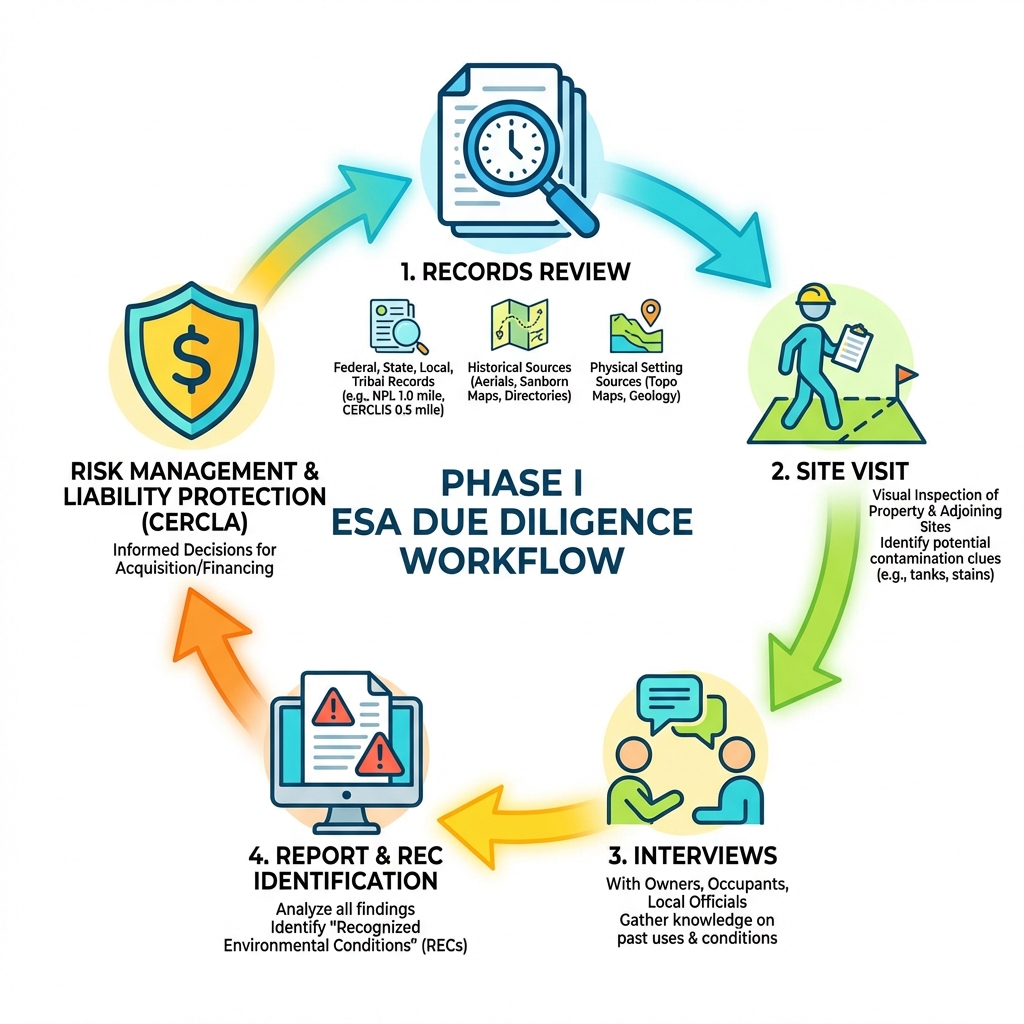
The process involves a comprehensive review of the property’s history and current conditions. This includes a thorough records review, a detailed site visit, and interviews with individuals knowledgeable about the property. The goal is to identify “Recognized Environmental Conditions” (RECs) that may indicate environmental contamination. For example, historical Sanborn maps might reveal past industrial uses, or government databases could show records of spills or hazardous waste sites nearby.

The records review component of a Phase I ESA involves consulting various sources to understand the property’s environmental history and current conditions. This typically includes:
- Federal, State, Local, and Tribal Records: These databases are searched for sites with known or suspected contamination, such as National Priorities List (NPL) sites, hazardous waste generators, leaking underground storage tanks (USTs), and permitted discharge facilities.
- Historical Sources: Aerial photographs, city directories, fire insurance maps (such as Sanborn maps), and chain-of-title documents are examined to identify previous land uses that may have involved hazardous materials.
- Physical Setting Sources: Topographic maps, geological surveys, and hydrological data help assess the potential for contaminant migration.
The search distances for these records are often standardized to ensure comprehensive coverage:
Standard Environmental Record Search Distances
- NPL (National Priorities List) and CORRACTS (Corrective Action Sites): 1.0 mile (1.6 km) from the subject property.
- CERCLIS (Comprehensive Environmental Response, Compensation, and Liability Information System) and State-equivalent sites: 0.5 mile (0.8 km) from the subject property.
- RCRA (Resource Conservation and Recovery Act) Generators (large quantity): 0.5 mile (0.8 km) from the subject property.
- Registered Underground Storage Tanks (USTs) and Leaking USTs (LUSTs): On the subject property and adjoining properties.
- State-equivalent hazardous waste sites: 0.5 mile (0.8 km) from the subject property.
Qualifications for Environmental Consulting and Safety Professionals
The integrity and legal defensibility of a Phase I ESA hinge entirely on the qualifications of the individual performing it. This is not a task for just anyone; it requires a specialized “Environmental Professional” (EP) as defined by the EPA’s AAI rule (40 CFR §312.10(b)) and ASTM standards. The EPA explicitly states that only an EP, or a person working under the supervision or responsible charge of an EP, can conduct an AAI-compliant Phase I ESA. Hiring an unqualified individual can render the entire assessment worthless for CERCLA liability protection, leaving property owners vulnerable to significant financial and legal repercussions.
An Environmental Professional must possess a specific combination of education, training, and experience to ensure they have the technical expertise to accurately identify potential environmental risks. The qualifications typically include one of the following:
EP Education and Experience Requirements
- Professional Licensure: A current Professional Engineer (PE) or Licensed Geologist (PG) license or registration, coupled with at least three years of relevant full-time experience.
- Advanced Degree: A bachelor’s degree or higher in engineering, environmental science, or a related discipline, combined with a minimum of five years of relevant full-time experience.
- Extensive Experience: Ten years or more of relevant full-time experience in environmental site assessments, even without a specific degree or licensure, provided the experience demonstrates equivalent knowledge and abilities.
Beyond these baseline requirements, an effective EP also needs practical experience relevant to the specific property type and geographic area. For instance, an EP experienced in industrial sites will be better equipped to identify nuances at a former manufacturing plant than one whose experience is limited to undeveloped land. Technical expertise encompasses a deep understanding of environmental regulations, contaminant behavior, site investigation techniques, and the ability to interpret complex historical and scientific data.
Identifying Recognized Environmental Conditions (RECs)
The core objective of a Phase I ESA is to identify Recognized Environmental Conditions (RECs). An REC signifies the presence or likely presence of hazardous substances or petroleum products on a property under conditions that indicate an existing release, a past release, or a material threat of a release into the environment. This determination is made through a rigorous process that includes:
- Site Reconnaissance: A physical inspection of the property and adjoining parcels to observe current conditions, look for signs of contamination (e.g., stained soil, stressed vegetation, unusual odors), and identify potential sources (e.g., storage tanks, waste disposal areas, vent pipes).
- Historical Aerial Photography and Chain-of-Title Review: These sources help reconstruct the property’s past uses and ownership, revealing changes that might have introduced environmental hazards. For example, a former dry cleaner or gas station on the site would be a significant red flag.
- Interviews: Discussions with current and past owners, operators, occupants, and local government officials can provide invaluable insights into the property’s history and any known environmental issues.
It’s important to understand the distinctions between different types of environmental conditions identified during a Phase I ESA:
- Recognized Environmental Conditions (RECs): As defined above, these are the primary focus and indicate a potential environmental liability.
- Controlled Recognized Environmental Conditions (CRECs): These are RECs that have been addressed to the satisfaction of a regulatory authority, but hazardous substances or petroleum products remain on the property, subject to specific controls (e.g., engineering controls such as a vapor barrier or institutional controls such as land-use restrictions).
- Historical Recognized Environmental Conditions (HRECs): These are past RECs that have been addressed to the satisfaction of a regulatory authority, and the hazardous substances or petroleum products no longer pose a threat to human health or the environment. No controls are typically required.
- De Minimis Conditions: These are environmental conditions that do not represent a REC and can be ignored. They are typically minor, localized releases that do not pose a material threat to human health or the environment and would not be subject to regulatory enforcement action. An example might be a small oil stain from a car on a paved parking lot that has been cleaned up.
The assessment also considers the potential for vapor encroachment, which is the migration of hazardous vapors from contaminated soil or groundwater into buildings. While a full vapor intrusion study is typically a Phase II scope item, the Phase I ESA will include a screening to identify potential sources and pathways.
Mitigating Hazardous Material Exposure During Construction
Once a Phase I ESA is complete, the findings dictate the next steps. If the Phase I ESA identifies RECs, the prudent course of action is often to proceed with a Phase II Environmental Site Assessment. This is where the non-intrusive nature of the Phase I gives way to more direct investigation.
A Phase II ESA is designed to confirm the presence or absence of contamination identified in the Phase I and to delineate its extent. This involves intrusive sampling and testing of various media.
Phase II ESA: Subsurface Investigation and Sampling
The scope of a Phase II ESA can vary widely depending on the RECs identified, but commonly includes:
- Soil Sampling: Collecting soil samples from boreholes or test pits to analyze for contaminants such as heavy metals, volatile organic compounds (VOCs), semi-volatile organic compounds (SVOCs), and petroleum hydrocarbons.
- Groundwater Contamination Assessment: Installing monitoring wells to collect groundwater samples and analyze them for a range of contaminants. This helps determine if contaminants have migrated into the groundwater and assess the risk to drinking water sources or surface water bodies.
- Soil Vapor Sampling: Collecting soil gas samples to evaluate the presence and concentration of VOCs in the subsurface, which can indicate a potential for vapor intrusion into buildings.
- Building Material Sampling: If Phase I indicates potential contamination within a building (e.g., from spills or historical operations), samples of concrete, dust, or other building materials may be collected.
The results of a Phase II ESA provide crucial data for informed decision-making in property transactions and construction plans. If contamination is confirmed, the report will typically include recommendations for further action, ranging from additional investigation to remediation or risk management strategies.
Here’s a comparison of the scopes of Phase I and Phase II ESAs:
Comparison of Phase I and Phase II Assessment Scopes
| Feature | Phase I Environmental Site Assessment | Phase II Environmental Site Assessment. It’s worth noting that while the EP conducts the assessment, the “user” (the party for whom the Phase I ESA is being performed, typically the buyer or lender) also has responsibilities. These include providing the EP with any special knowledge or experience they have regarding the property, any known environmental liens, and any commonly known or reasonably ascertainable information about the property.
Managing Chemical and Biological Hazards
Beyond RECs related to CERCLA hazardous substances and petroleum products, commercial properties can harbor a range of other chemical and biological hazards that require careful management, especially during construction or renovation. While these are typically considered “non-scope” issues for a standard Phase I ESA, a thorough environmental due diligence process often includes a review of these Business Environmental Risks (BERs) or recommends separate specialized surveys.
Key hazards include:
- Asbestos-Containing Materials (ACMs): Common in older buildings (pre-1980s), asbestos can be found in insulation, floor tiles, roofing materials, and other construction components. Disturbance during demolition or renovation can release asbestos fibers, posing a severe health risk. Identification and proper abatement are critical.
- Lead-Based Paint (LBP): Buildings constructed before 1978 are likely to contain LBP. Renovation activities can generate lead dust, which is particularly hazardous to children and construction workers. Lead paint surveys and proper lead-safe work practices are essential.
- Polychlorinated Biphenyls (PCBs): These toxic industrial chemicals were used in various building materials and electrical equipment (e.g., fluorescent light ballasts, caulk) until their ban in 1979. PCBs can pose risks during demolition and require specialized handling and disposal.
- Mold and Indoor Air Quality: Excessive moisture can promote mold growth, affecting indoor air quality and potentially causing health issues. While often not a direct “contamination” in the CERCLA sense, mold remediation can be a significant expense and delay.
- Vapor Intrusion Mitigation: If soil vapor sampling in a Phase II ESA indicates the presence of hazardous vapors in the subsurface, a vapor intrusion mitigation system (e.g., a sub-slab depressurization system or a vapor barrier) may be necessary to prevent these vapors from entering and accumulating in new or existing buildings, protecting occupants.
Effective management of these hazards requires specialized expertise and adherence to specific regulations. Environmental consulting firms often provide these additional services, from initial surveys to the development of hazardous materials handling plans and the oversight of remediation efforts. Integrating these assessments early in the project timeline can prevent costly surprises and ensure worker and occupant safety.
Integrating Environmental Consulting and Safety into Project Timelines
The timing of environmental assessments is paramount in commercial construction. A Phase I ESA is a snapshot in time, and its validity is not indefinite. According to ASTM standards, a Phase I ESA report is considered valid for 180 days from its completion date. If the property transaction or project initiation occurs within this timeframe, the report can be used directly.
However, if the assessment is between 180 and 365 days old, certain components must be updated. These updates typically involve re-checking regulatory databases, conducting new interviews, and re-performing the site reconnaissance to ensure that no new RECs have emerged or that conditions haven’t changed significantly. If the Phase I ESA report is older than 365 days, it is considered expired and must be fully re-performed to maintain its validity for AAI purposes. This “shelf life” ensures that the assessment reflects the most current understanding of the property’s environmental status.
Integrating environmental consulting and safety into project timelines from the outset is a critical risk management strategy. Proactive engagement allows for:
- Informed Decision-Making: Early identification of RECs allows buyers, lenders, and developers to factor potential environmental costs and liabilities into their financial models and negotiations.
- Streamlined Due Diligence: By understanding the assessment process and validity periods, project managers can schedule ESAs to align with transaction deadlines, avoiding last-minute rushes and costly updates.
- Budgeting for Contingencies: If a Phase I indicates a Phase II is likely, or if BERs such as asbestos are suspected, budget for these additional assessments and potential remediation early to prevent budget overruns later.
Consider complex projects like the Multi-Scope Due Diligence for Union Bank Plaza in Los Angeles or the Multi-Scope Due Diligence for Market Center in San Francisco. These large-scale redevelopments often involve intricate historical uses and multiple stakeholders. Conducting thorough, timely environmental assessments, including Phase I and, if applicable, Phase II ESAs, is essential to navigate regulatory requirements, secure financing, and manage the inherent risks of urban development. The cost of a proactive Phase I ESA is typically a small fraction of the overall project budget, yet it provides immense value by helping protect against potentially millions of dollars in cleanup costs and legal fees. This cost-benefit analysis overwhelmingly favors upfront investment in environmental due diligence as a cornerstone of responsible and successful commercial construction.