





Innovative Solutions for Industrial Dry and Wet Cleaning
Maintaining high standards of cleanliness in industrial environments is essential for operational efficiency, product quality, and regulatory compliance. Industrial cleaning methods have evolved significantly, integrating new technologies that address both dry and wet cleaning demands. Among these advancements, approaches such as hydro excavation vacuum methods are revolutionizing how facilities manage residue, contaminants, and waste while supporting sustainable practices.
Recent years have seen a surge in innovative equipment and automated systems, allowing businesses to streamline operations and reduce environmental impact. By leveraging these transformative solutions, industries can meet stricter hygiene protocols and minimize resource consumption. This includes reducing water and chemical use, improving waste management, and enhancing efficiency. Companies in sectors ranging from food processing and healthcare to semiconductor manufacturing are realizing significant performance improvements from these cleaner, smarter technologies.
Table of Contents
- 1 Dry-Ice Blasting: A Non-Abrasive Cleaning Method
- 2 Dry Clean-in-Place (CIP) Systems: Waterless Cleaning Solutions
- 3 Smart Dispensing Systems: Transforming Resource Efficiency
- 4 Cold Air Plasma Systems: Effective Chemical-Free Disinfection
- 5 High-Intensity Ultrasound: Non-Toxic Cleaning Innovation
- 6 Automated Cleaning with Robotics: Consistent and Precise Results
- 7 Vision Systems and Digital Twins: Proactive Cleanliness Management
- 8 Conclusion
Dry-Ice Blasting: A Non-Abrasive Cleaning Method
Dry-ice blasting offers a powerful yet gentle method for cleaning machinery and production lines. This process involves propelling solid CO2 pellets at high speeds, where they quickly sublimate upon contact, breaking down surface residues without eroding material. Since it leaves no lingering waste or moisture, it is especially valuable for delicate or electronic equipment and in settings where water or harsh chemicals are unsuitable. Dry-ice blasting is now widely used by the food processing, aerospace, and electronics industries and is increasingly adopted in sectors seeking a rapid, residue-free approach.
Dry Clean-in-Place (CIP) Systems: Waterless Cleaning Solutions
Water conservation is a growing concern for manufacturing and processing plants. Dry Clean-in-Place (CIP) technology addresses this challenge by using dry agents and targeted mechanical actions, virtually eliminating water use during cleaning. This system combines environmentally friendly solvents and thermal energy to remove deposits from equipment, minimizing the risk of microbial contamination while dramatically cutting water and chemical costs. The dry method also reduces downtime during drying, thereby increasing productivity in large-scale operations.
Smart Dispensing Systems: Transforming Resource Efficiency
Artificial intelligence has entered the industrial cleaning sector with smart dispensing systems that optimize the delivery of cleaning agents in real time. These smart systems use advanced sensors and algorithms to monitor supply levels and predict usage trends, ensuring products are dispensed only as needed. Facilities benefit from reduced waste, lower supply costs, and a smaller environmental footprint. AI-driven dispensing is particularly advantageous in large, multi-shift settings where manual inventory management can be inconsistent.
Cold Air Plasma Systems: Effective Chemical-Free Disinfection
For industries where even microscopic chemical residues pose a risk, such as food production and medical device manufacturing, cold-air plasma systems represent a breakthrough. Using electrically charged gases at room temperature, these systems deactivate bacteria, viruses, and spores without the need for traditional disinfectants. This technology limits exposure to hazardous substances and supports safer work environments. Oxford Academic has highlighted how cold-air plasma systems are redefining global industrial hygiene standards.
High-Intensity Ultrasound: Non-Toxic Cleaning Innovation
High-intensity ultrasound cleaning employs powerful sound waves to dislodge tiny particles from surfaces and intricate components. This non-toxic process creates microscopic bubbles in cleaning fluids, which collapse and generate focused shockwaves that remove contaminants. Ideal for healthcare, optics, and electronics, ultrasound cleaning provides thorough, uniform results without abrasive materials or chemical runoff. Facilities that adopt ultrasound report lower operational risks and higher levels of cleanliness, even for hard-to-reach or fragile equipment.
Automated Cleaning with Robotics: Consistent and Precise Results
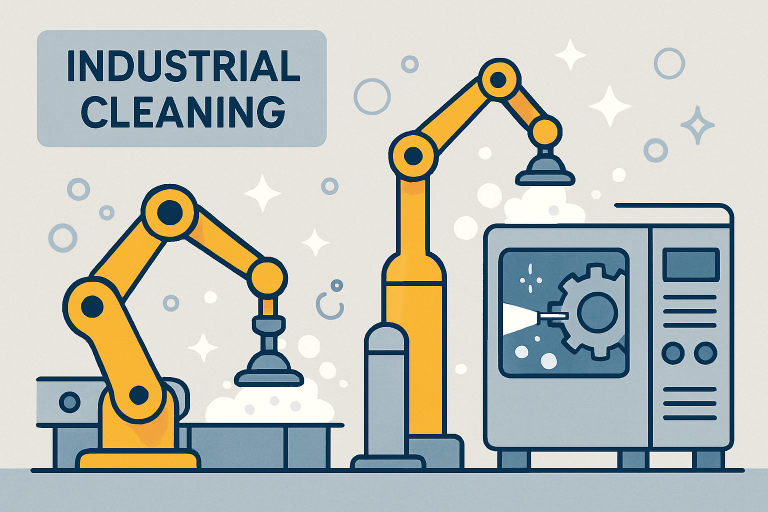
The rise of industrial robotics has transformed how routine cleaning, grinding, polishing, and surface treatment tasks are performed. Robotic systems equipped with sophisticated sensors and 3D vision can autonomously identify areas requiring attention, adjust their actions, and deliver precise, repeatable performance. Robotics ensures consistent cleaning standards, minimizes human error, and increases throughput. Additionally, such systems can operate in hazardous or high-contamination areas where worker safety would be a concern.
Vision Systems and Digital Twins: Proactive Cleanliness Management
Digital twin technology, coupled with modern vision systems, allows facilities to create virtual models of their environments and processes. These tools analyze performance data, predict contamination patterns, and automatically adjust cleaning cycles to maintain optimal conditions. The integration of digital twins supports predictive maintenance and real-time cleanliness monitoring, ensuring compliance with hygiene regulations and quality benchmarks. As public spaces and manufacturing floors adopt these systems, proactive cleanliness management becomes feasible and efficient.
Conclusion
Industrial cleaning is being transformed by a new generation of tools and automated systems, enabling businesses to achieve superior results with fewer resources. From non-abrasive dry-ice blasting and water-saving dry CIP systems to smart AI dispensers, robotic automation, and vision-based digital management, industries across the spectrum are benefiting from these innovations. Facilities that embrace these advanced cleaning solutions see improvements in sustainability, cost-effectiveness, and consistent hygiene, ultimately enabling them to meet the changing demands of modern industrial operations.

