
Innovations in Specialized Equipment for Industrial Applications
Table of Contents
- 1 Core Industries and Their Essential Specialized Machinery
- 2 Technological Innovations Driving the Evolution of Specialized Industrial Equipment
- 3 The Impact on Industrial Operations: Efficiency, Safety, and Sustainability
- 4 Navigating Challenges and Future Trends in the Market
- 5 Frequently Asked Questions about Specialized Industrial Equipment
- 6 Conclusion
Core Industries and Their Essential Specialized Machinery
 We live in an era where industrial success hinges on precision and efficiency. The backbone of this progress is often specialized industrial equipment. These machines are not just tools; they are the engines of innovation. In this extensive guide, we will explore what defines specialized industrial equipment, the key sectors that rely on it, and the technological advancements shaping its future. We will also look at its impact on efficiency, safety, and sustainability, as well as the challenges and emerging trends in this vital market.
Defining Specialized Industrial Equipment
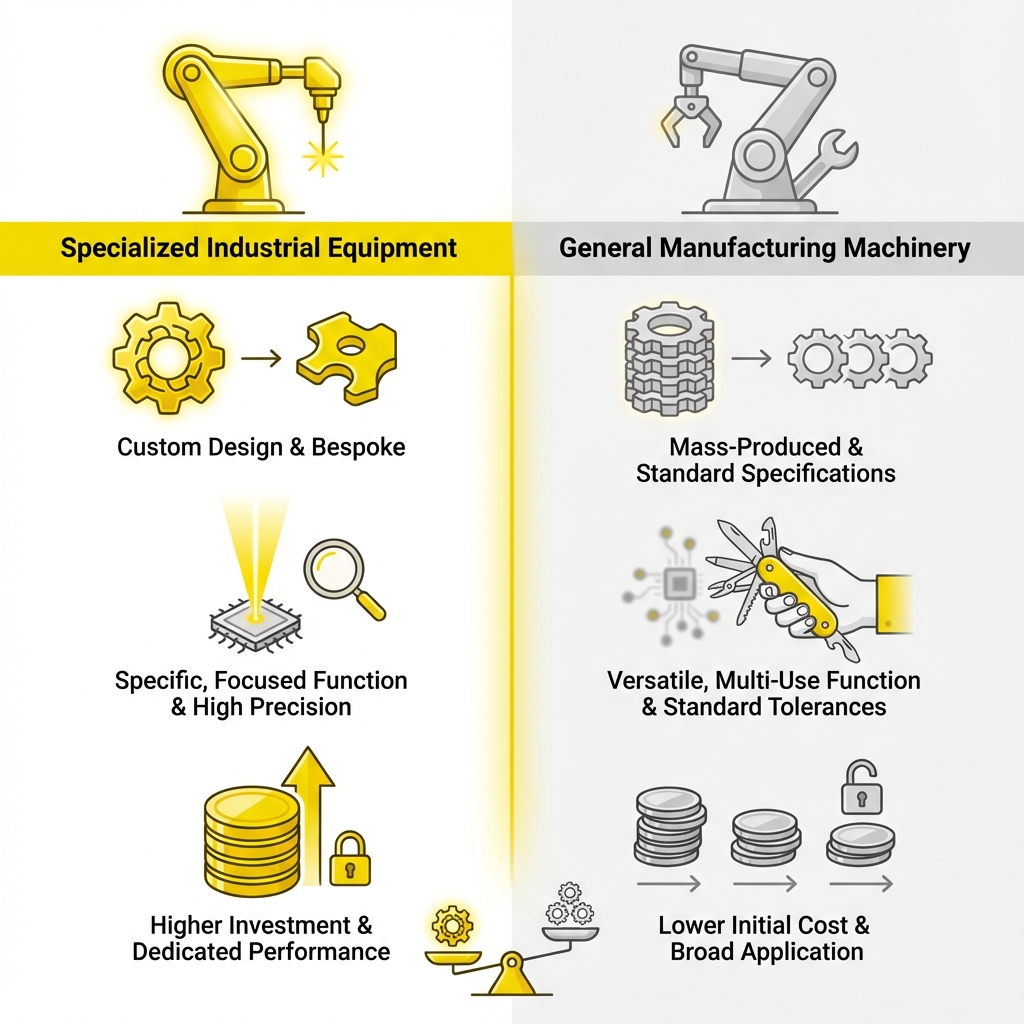
What exactly sets this equipment apart? It’s all about purpose-built design. Specialized industrial equipment is custom-engineered. It is designed for very specific tasks. This means it often uses high-performance materials. It also has integrated systems for single, focused functions. This is different from general-purpose machinery. General machines are made for many uses. Specialized equipment offers best accuracy and performance for its intended job.
General manufacturing machinery, while versatile and essential for broad production needs, is typically designed for a wide range of applications with standard specifications. In contrast, specialized industrial equipment is carefully crafted to meet the exact, often unique, demands of a particular process or environment. This distinction is crucial:
- Custom Design vs. Mass-Produced: Specialized equipment is often bespoke, custom to specific operational requirements, whereas general machinery is mass-produced for broader market appeal.
- Specific Function vs. Versatile Function: A specialized piece of equipment performs one or a very limited set of tasks with unparalleled efficiency and precision. General machinery, however, can be adapted for various functions, albeit often with compromises in performance for any single task.
- High Precision vs. Standard Precision: Specialized equipment is engineered for extreme accuracy, critical in industries like aerospace, medical device manufacturing, or semiconductor production. General machines operate within acceptable commercial tolerances.
- Higher Cost vs. Lower Cost: The custom engineering, advanced materials, and intricate design of specialized equipment naturally lead to a higher initial investment compared to more standardized, general-purpose machines.
This dedication to a single, focused function allows specialized equipment to achieve levels of performance, reliability, and safety that general-purpose machines simply cannot match. It’s the difference between a multi-tool and a surgeon’s scalpel – both are valuable, but one is designed for a specific, intricate purpose.
The Growing Market for Specialized Machinery
This focus on specialized solutions is fueling a strong market. In 2022, the global industrial machinery market was valued at USD 592.4 billion. Experts project it to reach USD 1,041.6 billion by 2032. This growth shows a 5.3% annual rate. This expansion is driven by economic needs and new technologies. Companies need these tools to stay competitive. They help businesses meet global demand.
This robust market growth underscores a fundamental shift in industrial strategy. As global competition intensifies and consumer demands for quality and customization rise, businesses are increasingly investing in equipment that can deliver exact results, optimize processes, and provide a competitive edge. The adoption of advanced technologies, the push for greater automation, and the need for improved safety and environmental compliance are all significant drivers behind this expanding market.

Specialized industrial equipment is not uniformly distributed across all sectors; rather, it is concentrated in industries where precision, power, safety, and specific operational requirements are paramount. These sectors often involve extreme conditions, complex processes, or high-value outputs that necessitate purpose-built solutions.
Heavy Industries: Mining, Construction, and Energy
In heavy industries, the sheer scale and challenging environments demand equipment that is robust, powerful, and designed for specific, often dangerous, tasks.
- Mining: This sector relies heavily on massive earthmovers, specialized drilling rigs capable of penetrating various geological formations, and industrial vacuum trucks for efficient material handling and cleanup in harsh conditions. For instance, Guzzler’s industrial vacuum loader trucks are engineered to handle everything from drill mud and dry bulk powders to industrial spills and thick sludge, showcasing the need for highly adaptable and powerful cleanup solutions.
- Construction: Large-scale construction projects use heavy-lifting gantries and strand jacks for erecting massive structures, along with pipe beveling machines for precise preparation of large diameter pipes. Equipment designed to withstand continuous heavy use and extreme environmental factors, such as those provided by Enerpac for heavy lifting technology or American Crane for custom overhead lifting, are critical.
- Energy (Oil & Gas, Power Generation): In these sectors, specialized equipment includes explosion-proof lighting for hazardous zones, precision boring machines for pipeline maintenance, and robust tools for offshore operations. The need for safety and reliability in potentially volatile environments means that equipment must meet stringent standards. For example, Durable specialized industrial equipment is essential for ensuring operational continuity and worker protection in these demanding settings, providing reliable illumination and power management in areas prone to explosions or corrosive elements.
Advanced Manufacturing and Aerospace
The demands of advanced manufacturing and aerospace are vastly different from heavy industries, focusing instead on extreme precision, intricate detail, and often, the manipulation of advanced materials.
- Aerospace: Manufacturing components for aircraft and spacecraft requires unparalleled accuracy. This includes advanced CNC machining centers capable of milling complex geometries from exotic alloys, automated robotic arms for precise assembly and quality control, and sophisticated composite material layup machines for lightweight, high-strength structures. Orbital welding systems are also critical for creating flawless, high-integrity joints in sensitive components.
- Semiconductor Manufacturing: This industry operates at the nanoscale, demanding equipment that can perform with microscopic precision in ultra-clean environments. Specialized tools include ultra-precise laser cutting machines for silicon wafers, advanced etching equipment, and robotic systems designed for cleanroom operations, ensuring zero contamination.
- Medical Device Manufacturing: Similar to semiconductors, this sector requires extreme precision and sterile conditions. Specialized equipment here might include micro-machining tools, automated assembly lines for small components, and specialized sterilization systems.
Key Applications of Specialized Industrial Equipment
Across these industries, the applications of specialized equipment are diverse, yet all share the common thread of requiring solutions beyond the capabilities of general machinery:
- Precision Welding: Critical for industries like aerospace and nuclear power, orbital welding systems (like those offered by S.F.E. Group’s brands such as AXXAIR and Magnatech) ensure consistent, high-quality welds in challenging configurations or confined spaces.
- Heavy Material Handling: From lifting multi-ton components in shipbuilding to moving massive turbines in power plants, specialized gantries, cranes, and skidding systems are indispensable.
- Sub-surface Drilling and Exploration: Equipment designed for deep-sea or subterranean environments, including specialized drills and remotely operated vehicles (ROVs), are crucial for resource extraction and geological surveys.
- Cleanroom Manufacturing: In semiconductor and pharmaceutical production, specialized equipment is designed to operate without introducing contaminants, often incorporating advanced filtration and automated handling systems.
- Hazardous Environment Operations: This includes equipment rated for explosive atmospheres (e.g., explosion-protected lifting technology from Demag) or those capable of remote operation to protect human workers from dangerous chemicals or radiation.
- Large-scale Fabrication: For massive structures like bridges or large industrial vessels, specialized cold cutting machines (such as TAG Pipe Equipment Specialists’ clamshell machines) and boring machines are used for precise shaping and finishing.
Technological Innovations Driving the Evolution of Specialized Industrial Equipment
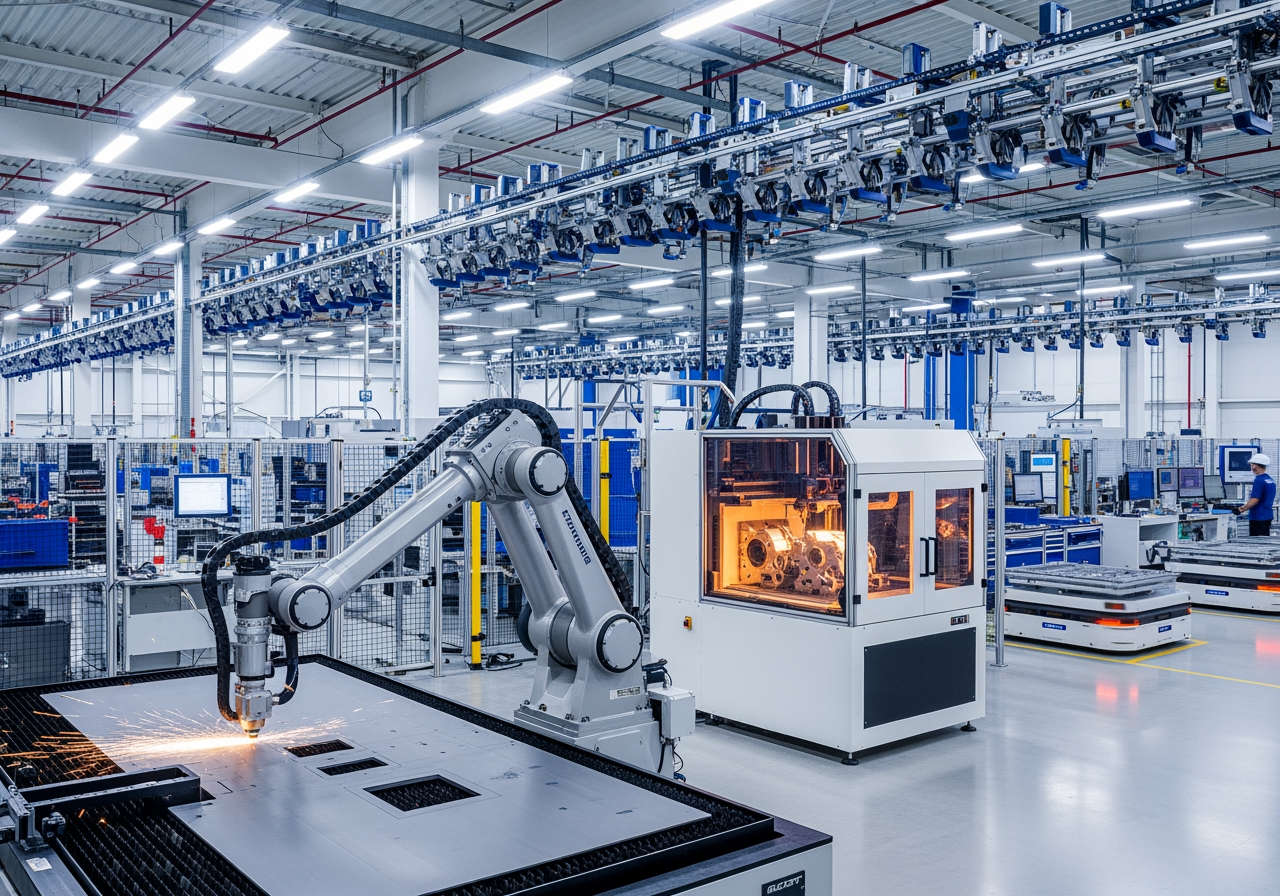
The landscape of specialized industrial equipment is undergoing a profound change, driven by rapid advancements in technology. These innovations are not merely incremental improvements but represent fundamental shifts in how machines operate, interact, and contribute to industrial processes.
Automation, Robotics, and Integrated Systems
The integration of automation and robotics is perhaps the most visible and impactful trend in specialized industrial equipment.
- Autonomous Mobile Robots (AMRs) and Collaborative Robots (Cobots): AMRs are revolutionizing logistics and material handling within factories, autonomously navigating complex environments to transport goods. Cobots, designed to work safely alongside human operators, are taking on repetitive or ergonomically challenging tasks, enhancing productivity without requiring extensive safety caging.
- Fully Automated Production Lines: In many advanced manufacturing sectors, entire production lines are now fully automated, from raw material input to finished product packaging. This level of automation relies on sophisticated specialized equipment that can communicate seamlessly with each other, execute complex sequences, and self-correct minor deviations.
- Reduced Human Intervention: Automation minimizes the need for human presence in hazardous or strenuous environments, significantly improving worker safety and allowing personnel to focus on higher-level tasks like supervision, programming, and maintenance.
- Increased Production Speed and Throughput: Automated systems operate continuously and at speeds far exceeding human capabilities, leading to dramatic increases in production volume and efficiency.
The success of these automated and robotic systems hinges on robust control and integration. Specialized industrial equipment solutions play a critical role in orchestrating these complex processes, ensuring that individual machines work in harmony, data flows efficiently, and operations are precisely controlled to achieve desired outcomes. These solutions often involve advanced programmable logic controllers (PLCs), human-machine interfaces (HMIs), and supervisory control and data acquisition (SCADA) systems.
The Role of Data: IIoT, AI, and Digital Twins
The proliferation of sensors and connectivity has ushered in an era where data is as valuable as the machinery itself, enabling unprecedented levels of insight and control.
- Industrial Internet of Things (IIoT): By connecting specialized equipment to the internet, IIoT enables real-time data collection from every sensor and actuator. This vast stream of data provides a comprehensive picture of machine health, performance, and operational parameters.
- Artificial Intelligence (AI) and Machine Learning (ML): AI algorithms analyze IIoT data to identify patterns, predict potential failures (predictive maintenance), optimize operational parameters for efficiency, and even enable machines to learn and adapt to changing conditions. This moves beyond simple automation to true machine intelligence.
- Digital Twin Simulations: A digital twin is a virtual replica of a physical piece of specialized equipment or an entire production line. Fed with real-time data from its physical counterpart, the digital twin can be used for simulations, testing new configurations, predicting performance under different scenarios, and optimizing maintenance schedules without impacting live operations.
- Data-Driven Decision Making: With AI and digital twins, operators and managers can make informed decisions based on concrete data rather than intuition, leading to better resource allocation, improved uptime, and higher quality output.
- Improved Connectivity: The backbone of data-driven operations is reliable connectivity. This requires not only robust network infrastructure but also durable physical connections. In harsh industrial environments, ensuring the integrity of data transmission is paramount, making Specialized industrial cable protection a non-negotiable component to prevent damage, signal loss, and costly downtime.
Innovations in Materials and Manufacturing Processes
The performance of specialized industrial equipment is also being redefined by breakthroughs in the materials used to construct them and the processes by which they are made.
- High-Performance Polymers and Advanced Composites: These materials offer superior strength-to-weight ratios, corrosion resistance, and thermal stability compared to traditional metals. They are increasingly used in components for aerospace, medical devices, and chemical processing, reducing weight, extending lifespan, and enabling operation in extreme environments.
- High-Yield Steel: While new materials emerge, traditional ones are also evolving. High-yield steel alloys provide exceptional strength and durability, allowing for the construction of lighter yet stronger heavy-duty equipment, such as cranes and towing vehicles, which can handle greater loads with improved fuel efficiency.
- Additive Manufacturing (3D Printing): 3D printing allows for the creation of complex geometries and customized parts that would be impossible or prohibitively expensive with traditional manufacturing. This is particularly valuable for prototyping specialized components, producing spare parts on demand, and creating intricate internal structures for improved performance (e.g., lightweighting or improved cooling).
- Non-Traditional Machining (EDM, ECM): Electrical Discharge Machining (EDM) and Electrochemical Machining (ECM) are advanced techniques used to precisely shape hard-to-machine materials or create intricate features without physical contact, reducing tool wear and enabling higher precision for specialized components.
- Lighter and Stronger Components: The combination of advanced materials and innovative manufacturing processes results in equipment components that are both lighter and stronger. This translates to improved energy efficiency, increased payload capacity, and improved durability, contributing to the overall performance and longevity of specialized industrial machinery.
The Impact on Industrial Operations: Efficiency, Safety, and Sustainability
The integration of specialized industrial equipment, bolstered by technological advancements, has a transformative impact on industrial operations. This impact is most evident in three critical areas: boosting productivity and precision, enhancing workplace safety, and supporting sustainability goals.
Boosting Productivity and Precision
Specialized equipment is fundamentally designed to maximize output and quality for its intended task.
- Increased Throughput: By automating repetitive tasks, operating at higher speeds, and minimizing downtime, specialized machines can significantly increase the volume of products or materials processed within a given timeframe. Their continuous operation capabilities, often 24/7, ensure maximum utilization.
- Reduction in Error Rates: Human error is a factor in any manual process. Specialized automated equipment, once programmed and calibrated, performs tasks with consistent accuracy, drastically reducing defects, rework, and scrap material.
- Consistent Quality Output: The high precision inherent in specialized machinery ensures that each product or component meets exact specifications, leading to uniform quality across batches. This consistency is vital in industries where deviation can lead to catastrophic failure or non-compliance.
- Improved Process Control: Advanced sensors and integrated control systems allow for real-time monitoring and adjustment of operational parameters. This granular control means processes can be fine-tuned for optimal performance, responding dynamically to changes in material properties or environmental conditions.
Enhancing Workplace Safety
One of the most significant benefits of specialized industrial equipment is its ability to create safer working environments, particularly in hazardous or strenuous industries.
- Robots for Hazardous Tasks: Robots can perform tasks that are dangerous, repetitive, or involve exposure to toxic substances, extreme temperatures, or heavy loads. This removes human workers from harm’s way, reducing the risk of accidents and injuries.
- Remote Operation and Monitoring: Many specialized machines can be operated and monitored remotely, allowing personnel to oversee processes from a safe distance. This is crucial in environments like nuclear facilities, deep-sea exploration, or chemical processing plants.
- Integrated Safety Sensors and Systems: Modern specialized equipment comes equipped with advanced safety features, such as proximity sensors, emergency stop buttons, and interlocks, which prevent operation under unsafe conditions or immediately halt machinery in case of an anomaly. Demag’s explosion-protected lifting technology, for example, is specifically designed for critical environments where safety is paramount.
- Ergonomic Equipment Design: Even for tasks that still require human interaction, specialized equipment is increasingly designed with ergonomics in mind, reducing physical strain on operators and preventing musculoskeletal injuries.
- Compliance with Safety Standards: Specialized equipment is often built to comply with rigorous industry-specific and international safety standards (e.g., OSHA, ISO 45001), ensuring a baseline of protection for workers.
Supporting Sustainability Goals
Beyond efficiency and safety, specialized industrial equipment contributes significantly to environmental stewardship and sustainable industrial practices.
- Energy-Efficient Machinery: Manufacturers are increasingly designing specialized equipment to consume less energy. This includes optimizing motor efficiency, implementing smart power management systems, and utilizing lightweight materials that require less energy to move.
- Waste Reduction: Precision manufacturing, reduced error rates, and optimized material usage directly translate to less waste. For instance, waterjet cutting machines can achieve intricate cuts with minimal material loss compared to traditional methods.
- Use of Recyclable Materials: The shift towards advanced materials also includes a focus on recyclability. Equipment components are being designed with materials that can be more easily recycled at the end of their lifespan, contributing to a circular economy.
- Extended Equipment Lifespan: High-quality construction, robust design, and predictive maintenance enabled by IIoT and AI extend the operational life of specialized equipment, reducing the frequency of replacement and the associated environmental impact of manufacturing new machines.
- Lower Carbon Footprint in Operations: The combined effects of energy efficiency, waste reduction, and optimized logistics contribute to a significantly lower carbon footprint for industrial operations that use advanced specialized equipment.
The journey of adopting and leveraging specialized industrial equipment is not without its problems. While the benefits are substantial, manufacturers and users must contend with significant challenges, even as the market continues to evolve with exciting new trends.
Overcoming Implementation and Operational Problems
The very nature of specialized equipment—its precision, complexity, and custom design—introduces unique challenges.
- High Capital Investment: The initial cost of acquiring specialized equipment is often considerably higher than general-purpose machinery. This necessitates thorough cost-benefit analyses and robust financial planning to justify the investment.
- Skilled Labor Gap: Operating, programming, and maintaining sophisticated specialized equipment requires a highly skilled workforce. There’s a persistent challenge in finding and retaining individuals with the necessary expertise in areas like robotics, automation, and data analytics. This often requires significant investment in training and upskilling existing employees.
- Maintenance Complexity: Specialized machines often feature intricate designs, proprietary components, and advanced software. Their maintenance can be complex, requiring specialized tools, diagnostic software, and highly trained technicians, which can be costly and time-consuming.
- System Integration Challenges: Integrating new specialized equipment into existing production lines and IT infrastructure can be a complex undertaking. Ensuring seamless communication and data flow between disparate systems, often from different vendors, requires careful planning and expert execution.
- The Importance of Certifications and Standards: To mitigate risks and ensure quality, certifications and standards play a crucial role. Adherence to standards like ISO 9001 (Quality Management), ISO 45001 (Occupational Health and Safety), and industry-specific certifications such as AS9100 for aerospace or EN 1090-1 for steel structures, is vital. These certifications not only assure quality and safety but also help differentiate offerings in a competitive market by demonstrating a commitment to excellence and compliance.
The Future of Specialized Industrial Equipment
Despite these challenges, the trajectory for specialized industrial equipment points towards continued innovation and expansion, driven by several key trends.
- Shift to Service-Based Models: Manufacturers are increasingly moving from simply selling equipment to offering “Equipment as a Service” (EaaS) or comprehensive service contracts. This includes predictive maintenance, remote monitoring, performance optimization, and even pay-per-use models, changing equipment into an ongoing solution rather than just a product. This helps users manage the high capital cost and maintenance complexity.
- Increased Demand for Customization: As industries become more niche and competitive, the demand for highly customized equipment will grow. Manufacturers will need to be agile in designing and producing bespoke solutions that precisely meet unique operational requirements.
- Rise of Modular Equipment Design: To address the need for customization while managing costs and lead times, modular design will become more prevalent. This allows for specialized equipment to be configured from standardized, interchangeable modules, offering flexibility and scalability.
- Integration of Circular Economy Principles: Future specialized equipment will be designed for longevity, repairability, and recyclability. This includes using sustainable materials, enabling easier component replacement, and facilitating end-of-life recycling to minimize environmental impact and resource consumption.
- Hyper-automation: Building on current automation trends, hyper-automation involves combining multiple advanced technologies—such as AI, machine learning, robotics, and process automation—to automate virtually every process that can be automated. This will lead to even more intelligent, autonomous, and efficient specialized industrial systems.
Frequently Asked Questions about Specialized Industrial Equipment
What is the primary benefit of investing in specialized industrial equipment over general-purpose machinery?
The primary benefit is a significant increase in efficiency, precision, and quality for a specific task. While general-purpose machines are versatile, specialized equipment is custom-engineered to perform its function faster, with fewer errors and often with less waste, providing a long-term competitive advantage. It allows businesses to achieve higher quality standards, reduce operational costs over time, and gain a competitive edge in markets demanding specific, high-performance outputs.
How is the Internet of Things (IoT) impacting specialized equipment?
IoT integration allows specialized equipment to be connected to a central network, enabling real-time data collection and analysis. This leads to benefits like predictive maintenance to prevent downtime, remote monitoring and control for improved safety, and process optimization based on live performance data. For example, sensors can track vibration, temperature, and pressure, feeding data into AI algorithms that predict when a component might fail, allowing for proactive maintenance rather than reactive repairs, maximizing uptime and operational efficiency.
What role do certifications and standards play in this sector?
Certifications like ISO 9001 (quality), ISO 45001 (safety), and industry-specific standards (e.g., AS9100 for aerospace, EN 1090-1 for structural steel) are crucial. They ensure that equipment is manufactured to the highest standards of quality, reliability, and safety, which is essential for critical applications in demanding environments. Adherence to these standards provides assurance to customers, facilitates international trade, and often demonstrates a manufacturer’s commitment to best practices, responsible engineering, and regulatory compliance.
Conclusion
Specialized industrial equipment is the cornerstone of modern, competitive industrial operations. Driven by innovations in automation, data analytics, and advanced materials, these machines are pushing the boundaries of efficiency, safety, and sustainability. From the heavy-duty demands of mining and construction to the microscopic precision of semiconductor manufacturing, purpose-built solutions are enabling industries to achieve previously unattainable levels of performance. While challenges in cost, maintenance complexity, and the skilled labor gap persist, the market’s future is bright, characterized by a shift towards service-based models, hyper-automation, and an unwavering commitment to customization and sustainability. Investing in and understanding specialized industrial equipment is not just about acquiring machinery; it’s about embracing a future where industrial processes are smarter, safer, and more efficient than ever before.