
The Evolution of Global Connectivity and Network Economics
Table of Contents
- 1 The Role of Modular Components in Modern Telecom and Connectivity Infrastructure
- 2 Technical Specifications and Conductor Compatibility
- 3 Installation Best Practices and Safety Standards
- 4 Comparative Analysis: Lever-Nuts vs. Traditional Splicing
- 5 Frequently Asked Questions about Inline Splicing
- 6 Conclusion
The Role of Modular Components in Modern Telecom and Connectivity Infrastructure
The intricate web of modern telecom and connectivity infrastructure relies heavily on components that are not only robust and reliable but also adaptable and efficient. As data demands soar and networks expand, the underlying physical connections must keep pace, offering solutions that enhance scalability and maintain signal integrity. This is where modular components, particularly advanced splicing connectors, demonstrate their indispensable value.
Consider the complexity of wiring in a high-density server rack or a sprawling data center. Every connection must be secure, easily verifiable, and, ideally, reconfigurable without compromising the entire system. Traditional methods often fall short in these demanding environments, leading to time-consuming installations, increased risk of human error, and difficulties during maintenance or upgrades.
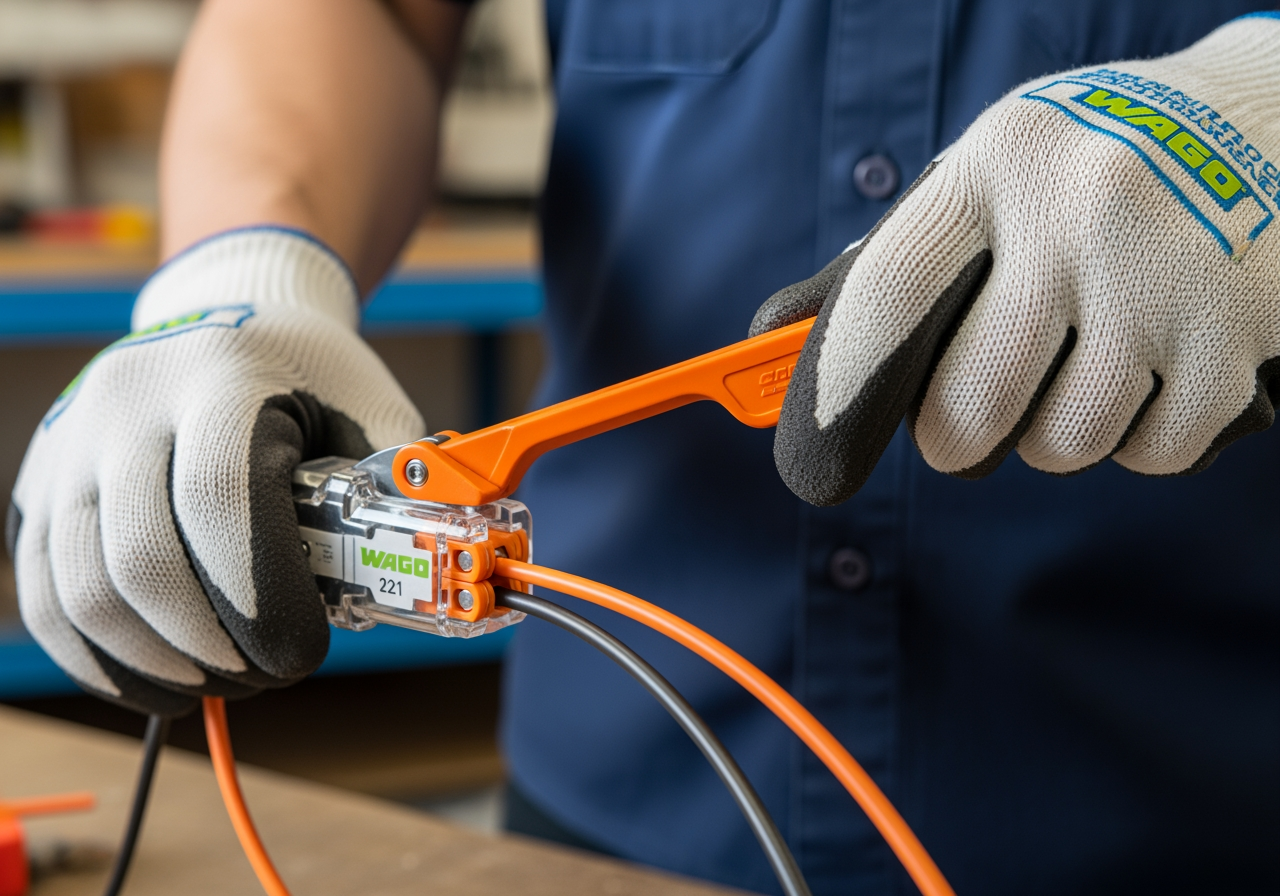
This challenge has driven the development of innovative solutions, such as the WAGO 221-2401 inline splicing connectors. These connectors represent a significant leap forward in electrical connection technology, offering a compact, user-friendly, and highly reliable alternative to older splicing methods. Their 2-conductor design, coupled with a transparent housing and a white cover, allows for immediate visual inspection of the connection, ensuring proper wire insertion and the correct strip length. This transparency is not just an aesthetic choice; it’s a critical feature that enhances safety and reliability in the field. The inherent modularity of these connectors allows connections to be added, removed, or modified with minimal disruption, a crucial advantage in dynamic network environments where infrastructure must evolve rapidly. For professionals seeking efficient and reliable solutions, exploring options like these advanced inline wago connectors is essential.

Streamlining Network Economics with Inline Splicing in Telecom and Connectivity Infrastructure
The economic implications of choosing the right connector are profound, extending beyond the initial purchase price to encompass labor costs, maintenance, and long-term reliability. Inline splicing connectors, particularly the WAGO 221-2401, are designed with these economic factors in mind, offering a compelling case for their adoption in modern telecom and connectivity infrastructure.
One of the most immediate benefits is the significant reduction in installation time and labor costs. Unlike traditional wire nuts that require twisting and often multiple attempts for a secure connection, or soldering, which demands specialized tools and skills, WAGO’s lever-nut technology enables tool-free installation. This simplicity translates into faster project completion times and reduced labor expenses, directly impacting the overall cost-per-connection. For instance, a 60-piece pack of WAGO 221-2401 connectors can be priced around $23.94, breaking down to approximately $0.40 per connector. This competitive pricing, combined with rapid installation, makes them an economically attractive option.
The reliability of these connectors further contributes to network economics. With an impressive average of 4.9 out of 5 stars from thousands of customer reviews (e.g., 1,219 reviews for a 60-piece pack, 805 for a 20-piece pack), users consistently praise their performance and durability. This high level of satisfaction underscores their maintenance-free operation, minimizing the need for costly callbacks or troubleshooting. The WAGO 221 series, including the inline variants, has established a reputation for creating secure, vibration-proof connections that maintain excellent contact quality over extended periods. This long-term stability is a critical factor in reducing operational expenditures and ensuring consistent network uptime, which is paramount in telecom infrastructure.
Versatile Applications in Commercial and Industrial Networks
The utility of inline WAGO connectors spans a broad spectrum of commercial and industrial applications, demonstrating their adaptability and robust performance across diverse environments. Their design addresses common pain points in electrical wiring, making them a preferred choice for both professional electricians and DIY enthusiasts.
In electrical panels, these connectors excel at creating clean, straight-through extensions for short wires, eliminating the messy, bulky splices often associated with traditional wire nuts. This “panel extension” capability allows for more organized wiring, improved airflow, and easier access for future modifications or troubleshooting. Similarly, in situations requiring “short wire remediation,” such as when existing wiring needs to be lengthened to reach new fixtures or components, inline WAGO connectors provide a quick and reliable solution without resorting to unsightly or less secure methods.
For lighting systems, particularly LED installations, inline connectors offer a streamlined approach to wiring. They can be used to splice wires within fixtures, extend runs, or connect components in a compact and secure manner. This is particularly beneficial in areas with limited space, such as behind wall switches or in junction boxes. The ease of use also makes them popular for HVAC controls, where multiple low-voltage wires must be reliably connected.
Beyond fixed installations, their robust connection and ease of use make them suitable for certain low-voltage applications in other sectors. For instance, in car audio installations, where quick and secure splices are often needed, these connectors can significantly simplify the process. However, it’s important to note that their primary design is for building electrical systems, and specific automotive-grade connectors may be preferred for harsh environments with extreme vibration and temperature fluctuations. Similarly, for extending speaker wire, the WAGO 221-2401 provides a clean, efficient connection.
The availability of mounting carriers further enhances their versatility, enabling secure installation on DIN rails or with screws. This feature is invaluable in industrial control cabinets or other structured wiring environments where organization and stability are paramount. Whether optimizing junction box space or ensuring reliable connections in complex commercial setups, inline WAGO connectors are an invaluable tool.
Technical Specifications and Conductor Compatibility
Understanding the technical specifications and conductor compatibility of WAGO 221-2401 inline splicing connectors is crucial for ensuring safe and effective application. These connectors are engineered to handle a specific range of wire sizes and types, offering flexibility while maintaining stringent safety standards.
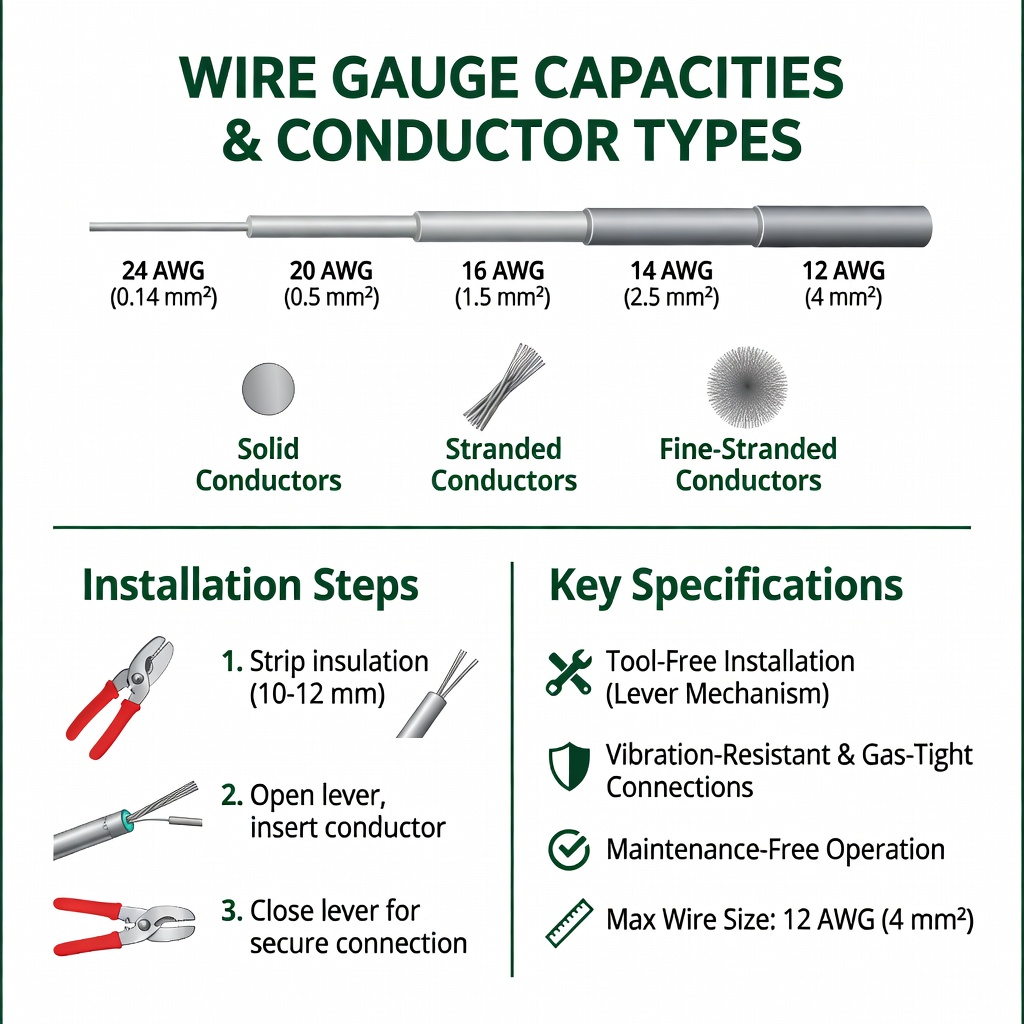
The WAGO 221-2401 is primarily a 2-conductor inline splicing connector. A key feature is its broad compatibility with various conductor types, including solid, stranded, and fine-stranded wires. This versatility makes them suitable for a wide array of electrical applications, from household wiring to more complex industrial setups.
Regarding wire sizes, the 221-2401 supports conductors up to 12 AWG maximum. While the maximum is 12 AWG, the general operating range for the 221 series is often cited as 24-12 AWG (0.14 – 4 mm²). However, for the specific inline 221-2401, the maximum capacity is 12 AWG, with some specifications indicating a range of 20-14 AWG for certain applications, highlighting the importance of consulting the specific product datasheet for precise ratings. The maximum cross-section for these connectors is 4 mm².
The ability to handle different conductor types without special tools or preparation (other than stripping) is a significant advantage. Solid conductors can be easily inserted after stripping, while stranded and fine-stranded wires are securely clamped by the lever mechanism, ensuring a gas-tight and vibration-proof connection. This eliminates the need for wire ferrules, simplifying the installation process and reducing material costs.
Here’s a general overview of wire gauge capacities and conductor types for the WAGO 221 series, which the 221-2401 belongs to:
This broad compatibility ensures that electricians and technicians can rely on a single connector type for various wiring tasks, streamlining inventory and simplifying installation procedures.
Installation Best Practices and Safety Standards
Proper installation and adherence to safety standards are paramount when working with any electrical connector, and WAGO inline splicing connectors are no exception. While designed for ease of use, following best practices ensures maximum safety, reliability, and compliance with electrical codes.
The installation process for WAGO 221-2401 connectors is remarkably straightforward, largely due to their innovative lever-actuated design.
[LIST] of installation steps:
- Prepare the Wires: Ensure the power to the circuit is off. Strip approximately 9-11 mm (about 0.35 to 0.43 inches) of insulation from the ends of the wires to be connected. The transparent housing of the 221-2401 allows for visual verification of the correct strip length once the wire is inserted.
- Open the Levers: For each wire, lift the orange operating lever to its fully open, upright position. The recessed handles provide an easy grip for this action.
- Insert the Conductor: Insert the stripped end of the wire fully into the connection port. The transparent housing allows you to visually confirm that the conductor is correctly seated and the copper is visible, indicating proper contact.
- Close the Levers: Push the operating lever back down until it clicks into place, securing the wire. This action creates a firm, gas-tight connection using WAGO’s CAGE CLAMP® spring pressure technology.
- Repeat for Second Wire: Follow steps 2-4 for the second wire on the opposite side of the inline connector.
- Verify Connection: Gently tug on each wire to ensure it is securely held. The transparent housing provides a final visual check that the connection is solid.
One of the significant safety and convenience features of the WAGO 221 series, including the inline models, is the presence of built-in test ports. These ports allow voltage testing from both sides of the connector, even after installation, without disconnecting the wires. This capability is invaluable during troubleshooting, as it enables electricians to quickly and safely verify the presence or absence of voltage, minimizing downtime and enhancing safety.
Safety Certifications and Environmental Ratings
The robust design and performance of WAGO 221 series inline connectors are backed by comprehensive safety certifications and environmental ratings, providing assurance of their quality and reliability in various applications. These certifications are critical for compliance with electrical codes and for ensuring the safety of installations.
WAGO 221 series connectors are UL Listed, meaning they have been tested and found to meet the rigorous safety standards established by Underwriters Laboratories, a globally recognized safety science company. This listing is essential for electrical components used in North America, confirming their suitability for a wide range of building and industrial applications.
In addition to UL listing, these connectors often comply with VDE standards, which are German national standards for electrical engineering, electronics, and information technology. VDE certification signifies adherence to high European safety and quality benchmarks.
Furthermore, WAGO connectors are typically RoHS compliant. RoHS (Restriction of Hazardous Substances) is a directive that restricts the use of specific hazardous materials found in electrical and electronic products. RoHS compliance indicates that the connectors are environmentally friendly and safe from certain toxic substances.
Environmental ratings, such as the T85 temperature rating, specify the maximum permissible surrounding air temperature for the connector, which is 85°C. This rating ensures that the connectors can safely operate without degradation at typical and moderately elevated ambient temperatures, which are crucial for maintaining long-term electrical integrity.
The underlying spring pressure technology and CAGE CLAMP® mechanism are inherently designed for superior performance, offering vibration resistance that ensures stable connections even in dynamic environments. This robust mechanical design, combined with material choices that resist aging and environmental factors, contributes to the overall safety and longevity of the connection. These certifications and ratings collectively underscore WAGO’s commitment to safety and quality in its electrical interconnect solutions.
Comparative Analysis: Lever-Nuts vs. Traditional Splicing
The advent of WAGO lever-nut connectors, especially the inline variants, has sparked a significant shift in how electricians and DIYers approach wire splicing. A comparative analysis with traditional methods such as wire nuts and soldering reveals distinct advantages that enhance efficiency, safety, and reliability.
Against Traditional Wire Nuts: Traditional wire nuts have been a staple in electrical wiring for decades. They work by twisting wires together and then screwing on a conical spring-loaded plastic cap. While inexpensive, their effectiveness heavily relies on the installer’s skill. Improper twisting can lead to loose connections, increased resistance, and potential fire hazards. They are also generally not reusable, and inspecting the splice quality without removing the nut is impossible.
WAGO lever-nuts, in contrast, offer a tool-free, visually verifiable, and reusable solution. The lever mechanism ensures a consistent, secure connection regardless of operator skill. The transparent housing of the 221-2401 allows for immediate visual inspection of the wire’s strip length and proper insertion, eliminating guesswork. Furthermore, WAGO connectors are designed for easy removal and re-use, making circuit modifications or troubleshooting much simpler and less destructive. This reusability is a major advantage, especially in temporary setups or systems that require frequent reconfigurations.
Against Soldering: Soldering creates a highly conductive and mechanically strong connection, often considered the gold standard for certain applications. However, it is a time-consuming process that requires specialized tools (soldering iron, solder), materials (flux), and significant skill. It also introduces heat into the connection, which can damage wire insulation if not done carefully. Once soldered, connections are permanent and difficult to alter without cutting and re-soldering, which can shorten wires over time.
Lever-nuts provide a fast, clean, and equally reliable alternative to soldering. They eliminate the need for heat, fumes, and specialized training, making them a safer and more accessible option for a broader range of users. While soldering might be preferred in niche, high-vibration, or extreme-temperature applications (though WAGO’s spring pressure technology offers excellent vibration resistance), for general electrical splicing, lever-nuts offer a superior balance of speed, ease, and reliability.
Space-Saving Design: The compact nature of WAGO connectors is another significant advantage. Some WAGO solutions, like picoMAX®, are up to 30% more compact than traditional terminal blocks. While the 221-2401 is an inline connector, its streamlined design improves wire management and can free up valuable space in junction boxes or enclosures, which is often at a premium in modern installations.
Future-Proofing Telecom and Connectivity Infrastructure through Maintenance-Free Design
The concept of “future-proofing” infrastructure is increasingly vital in the rapidly evolving fields of telecom and connectivity. This involves selecting components that not only meet current demands but also offer adaptability, longevity, and minimal maintenance requirements for years to come. The maintenance-free design of WAGO lever-nut inline connectors plays a crucial role in achieving this objective.
The core of WAGO’s reliability lies in its spring pressure technology. Unlike screw terminals that can loosen over time due to vibration, thermal cycling, or material creep, spring clamps maintain a constant, optimal contact force on the conductor. This ensures a gas-tight, vibration-proof, maintenance-free connection that eliminates the need for periodic re-tightening. This long-term contact quality is critical for preventing intermittent connections, signal degradation, and potential fire hazards, ensuring the long-term reliability of the electrical system.
This inherent stability translates directly into reduced operational costs and increased system uptime. In telecom and connectivity infrastructure, where service continuity is paramount, minimizing unscheduled maintenance and troubleshooting is a significant economic advantage. The design also facilitates easy wire removal, allowing quick circuit troubleshooting or modifications without damaging the connector or the wire. This modularity supports scalability and modular upgrades, as sections of a network can be easily reconfigured or expanded by simply opening and closing levers, rather than cutting and re-splicing.
The transparent housing of the 221-2401 also contributes to future-proofing by allowing for quick visual checks. Technicians can instantly verify proper strip length and wire insertion, reducing the likelihood of installation errors that could lead to future failures. This ease of inspection simplifies maintenance routines and accelerates fault-finding.
Frequently Asked Questions about Inline Splicing
As with any innovative electrical component, users often have specific questions regarding the application, compatibility, and distinctions of inline splicing connectors. Here, we address some of the most common inquiries about WAGO 221-2401 inline connectors.
What are the main differences between inline and standard lever-nuts?
The primary distinction lies in their intended function and physical configuration.
Standard Lever-Nuts (e.g., WAGO 221-412, 221-413, 221-415): These are typically designed for “pigtail” connections or multi-port distribution. They usually have multiple ports on one side (e.g., 2, 3, or 5 ports) and sometimes one or more ports on the other side, allowing multiple wires to be connected together or a single incoming wire to branch into several outgoing wires. They are generally used to bundle wires within a junction box or enclosure. Their form factor is often wider and shorter.
Inline Lever-Nuts (e.g., WAGO 221-2401): The 221-2401 is specifically designed for a “straight-through” connection, essentially extending a single wire or creating a splice between two wires in a linear fashion. It features one connection port on each end, making it ideal for extending short wires or repairing breaks in a continuous run. The “inline” design means the wires enter and exit along the same axis, resulting in a more streamlined and compact splice that fits neatly within cable runs or tight spaces. This 2-conductor limit is a key characteristic of the inline design, distinguishing it from the multi-port distribution capabilities of standard lever-nuts. The aesthetic differences are also notable; the inline connector maintains a continuous flow, which can be advantageous in visible installations or when space is at a premium.
Can these connectors be used for aluminum-to-copper connections?
No, WAGO 221-2401 inline splicing connectors are designed for copper wire only. Using them for aluminum-to-copper connections is generally not recommended and can pose significant safety risks, including a potential fire hazard.
Aluminum and copper have different electrical and thermal expansion properties. When directly connected without specialized connectors, the aluminum wire can oxidize and creep (deform under constant pressure), leading to loose connections, increased resistance, and overheating at the splice point.
For aluminum-to-copper connections, you must use approved connectors specifically designed and listed for this purpose, such as specialized CO/ALR-rated twist-on connectors or crimp connectors with antioxidant paste. Always consult local electrical codes and manufacturer guidelines for safe and compliant wiring practices when dealing with dissimilar metals.
Are inline connectors suitable for high-vibration environments?
Yes, WAGO inline connectors, such as the 221-2401, are well-suited for many high-vibration environments thanks to their robust spring pressure technology.
The CAGE CLAMP® spring mechanism provides a constant, reliable contact force on the conductor, making the connection inherently resistant to loosening from vibrations. This is a significant advantage over screw-type terminals, which can back out over time in dynamic conditions.
WAGO connectors are often rated for vibration resistance up to 20g, making them suitable for applications where mechanical stress is a concern. This makes them a strong choice for industrial machinery, control panels, and even some transportation applications. While they are not specifically designed as automotive-grade connectors (which often require additional sealing and environmental protection against extreme temperatures, moisture, and chemicals), their vibration resistance makes them a superior choice compared to traditional wire nuts or even some crimp connectors in many demanding environments. For applications like marine use, where constant motion and vibration are present, their secure clamping provides a reliable connection. Always check the specific product’s technical data sheet for detailed environmental and mechanical ratings relevant to your application.
Conclusion
The journey through the evolution of global connectivity and network economics reveals a clear trend towards greater efficiency, reliability, and adaptability across all components. Inline WAGO connectors, particularly the 221-2401 series, stand out as exemplary innovations in this landscape. Their compact design, tool-free lever operation, and transparent housing embody a commitment to simplifying complex wiring tasks while enhancing safety and performance.
We’ve seen how these connectors streamline network economics by reducing installation time and labor costs, offering a highly competitive cost-per-connection. Their exceptional customer satisfaction ratings and maintenance-free operation underscore their long-term reliability, minimizing costly interventions and ensuring consistent network uptime. From tidying up electrical panels and extending short wires to providing robust connections in lighting systems and HVAC controls, their versatility underscores their indispensable role across commercial and industrial networks.
The technical prowess of WAGO inline connectors, including their broad conductor compatibility up to 12 AWG and adherence to stringent safety certifications like UL Listed and VDE standards, ensures they meet the highest industry benchmarks. Their inherent vibration resistance and maintenance-free spring pressure technology offer a compelling alternative to traditional wire nuts and soldering, providing a future-proof solution that supports modular upgrades and simplifies troubleshooting.
In an interconnected world where every splice matters, the choice of electrical components profoundly impacts network reliability and infrastructure efficiency. By embracing modern splicing solutions, we contribute to a more robust, adaptable, and economically viable global connectivity infrastructure, ensuring long-term contact quality and seamless data flow for generations to come.