





Optimizing Efficiency in Modern Bulk Material Handling and Thermal Processing
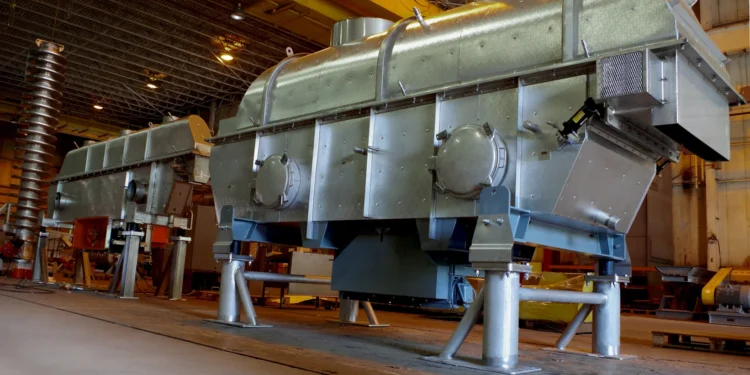
Table of Contents
- 1 The Role of Advanced Industrial Processing Equipment in Material Flow
- 2 Fundamentals of Fluid Bed Processors and Thermal Exchange
- 3 Key Applications for High Performance Systems
- 4 Feature Fluid Bed Drying Flash Drying Material Type Granular, crystalline, agglomerated, coarser powders Fine, wet, pasty, heat-sensitive materials Residence Time Longer, controlled Very short (seconds) Heat Transfer Convective, highly efficient Convective, extremely rapid Particle Size Broad range (50 μm to 10 mm) Typically very fine Attrition Low to moderate Moderate to high (due to high velocity) Applications Drying, cooling, granulation, coating Primarily drying, often with de-agglomeration Energy Usage Efficient for various loads Can be very efficient for specific applications Equipment Size Can be compact for throughput Often more compact for high evaporation rates Critical Parameters for Operating Fluid Bed Systems
- 5 Frequently Asked Questions about Fluid Bed Technology
- 6 Conclusion: Engineering for Process Reliability
The Role of Advanced Industrial Processing Equipment in Material Flow
 Achieving peak efficiency in modern industrial operations, especially in bulk material handling and thermal processing, is a critical objective. Companies strive for methods that are both effective and economical. This is where fluid bed processors emerge as a cornerstone technology.
These versatile machines are central to transforming raw materials across various industries. They are essential for processes like drying, granulation, coating, and cooling. Understanding how they work is key to optimizing production.
In this extensive guide, we will delve into fluid bed processors. We will explore their basic principles, how they function, and their wide-ranging applications. Our aim is to provide a clear understanding of their role in enhancing product quality and process efficiency. We will also discuss critical operating parameters and look at the latest advancements in this field.
Maintaining a stable and predictable material flow is paramount in any industrial setting. Disruptions can lead to costly downtime, reduced product quality, and decreased overall efficiency. This is particularly true in bulk material handling, where materials often undergo multiple processing steps. Advanced industrial processing equipment, such as fluid bed processors, plays a pivotal role in ensuring this stability.
Custom engineering is often required to meet the unique challenges presented by diverse materials and process requirements. Equipment must be designed not only for optimal performance but also for durability, especially when handling abrasive materials. Abrasion resistance ensures a longer lifespan for components, reducing maintenance costs and increasing uptime.
Many fluid bed systems are built for continuous-duty operation, allowing for uninterrupted processing and maximizing throughput. This continuous operation often goes hand-in-hand with a focus on energy efficiency. Modern designs aim to minimize power consumption while achieving superior processing results. For instance, some systems boast up to 50% shorter process times for pellet coating and up to 25% for granulation, directly translating to energy savings and increased productivity.
The integration of Vibratory fluid bed processing further enhances material flow and processing efficiency. Vibration helps to overcome issues like channeling, sticking, and agglomeration, ensuring uniform treatment of materials. This combination of fluidization and mechanical vibration creates a highly effective environment for thermal processing.
Enhancing Industrial Processing Equipment with Vibration
Vibration, when applied strategically, significantly enhances the capabilities of industrial processing equipment. In fluid bed systems, natural-frequency vibration can lead to more stable material flow, particularly for challenging materials that might otherwise clump or resist fluidization. This mechanical assistance reduces the reliance on high air velocities alone, which can lead to excessive dust generation or particle attrition.
The benefits extend beyond improved material handling. Vibration can reduce mechanical wear on internal components by preventing material buildup and ensuring a smoother flow path. Furthermore, it can contribute to lower power consumption by optimizing the fluidization process, meaning less energy is needed to achieve the desired material suspension. For a deeper understanding of how this technology works, explore the mechanisms behind Vibrating Fluid Beds: How They Work.
Vibrating fluid beds are incredibly versatile, capable of handling a wide array of materials and processes. They are often employed in applications requiring precise temperature control, such as with Vibrating Coolers, where consistent cooling is essential to product quality. The gentle yet thorough agitation provided by vibration ensures that all particles are exposed uniformly to the processing environment, leading to consistent results batch after batch.
Fundamentals of Fluid Bed Processors and Thermal Exchange
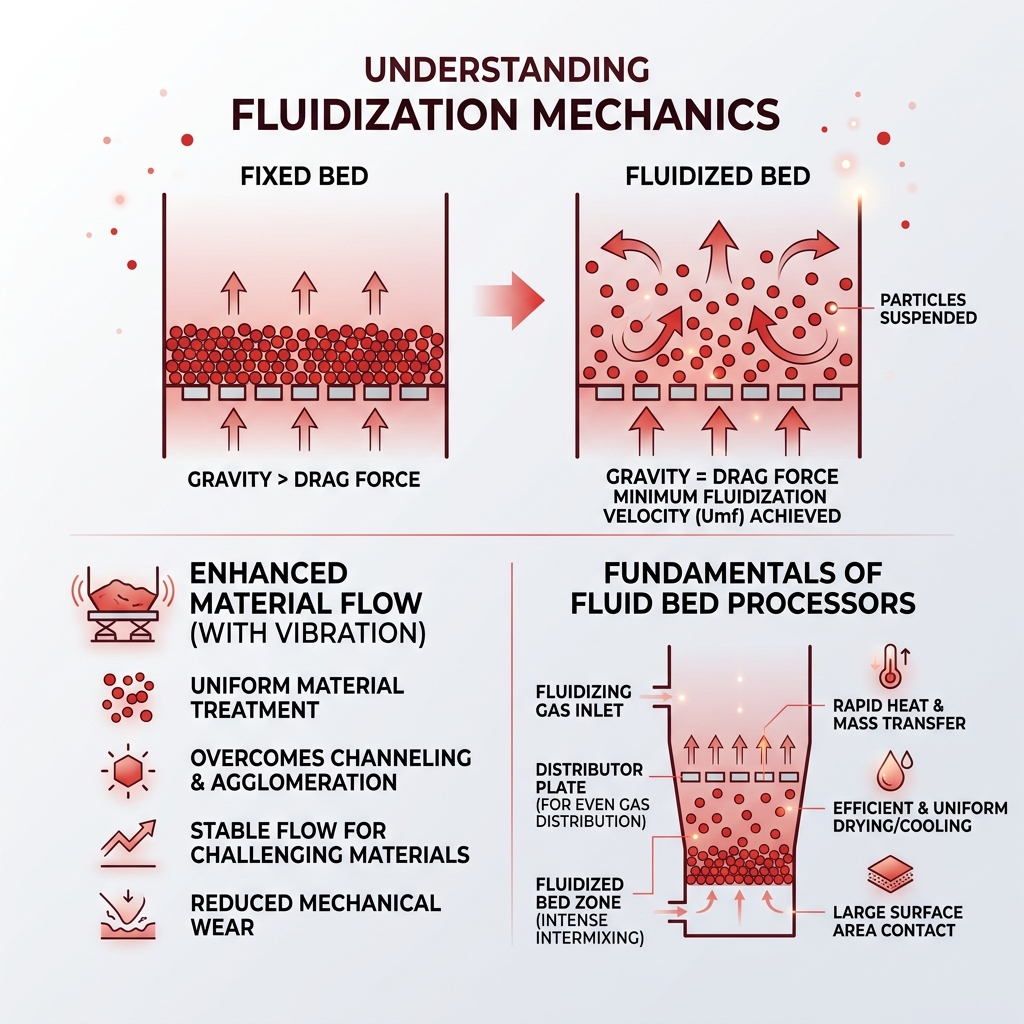
At its core, a fluid bed processor operates on the principle of fluidization. This phenomenon occurs when a gas (usually air) is passed upwards through a bed of solid particles at a velocity sufficient to suspend the particles, causing the bed to behave like a fluid. This state of “fluidization” is achieved when the drag force and buoyant force exerted by the upward-moving gas balance the gravitational force acting on the particles. The minimum fluidization velocity is the critical point at which this suspension begins. You can learn more about this fascinating phenomenon, which creates conditions akin to quicksand, in our article Fluidization Creates Both Quicksand and Fluid Bed Processing.
The process typically begins with a distributor plate, a perforated surface through which the fluidizing gas enters the processing chamber. This plate ensures an even distribution of gas across the entire bed of material. Once fluidized, the particles are in constant, vigorous motion, creating an intimate contact between the solid particles and the fluidizing gas. This intense intermixing is crucial for highly efficient heat transfer and mass transfer.
Heat transfer occurs rapidly because each particle is surrounded by the heated gas, allowing for quick and uniform heating or cooling. Similarly, mass transfer, such as the evaporation of moisture during drying or the absorption of a coating solution, is highly effective due to the large surface area contact between the particles and the gas or sprayed liquid. The result is a highly efficient and uniform process.
Fluid bed processors are designed with various configurations to optimize these fundamental principles for specific applications. For instance, laboratory-scale units, such as the ProCell®LabSystem, allow researchers to experiment with top spray, bottom spray, and Wurster coating methods in both continuous and batch operations, providing maximum flexibility for process development. This modularity ensures that the fundamentals of fluidization can be finely tuned for diverse materials and desired end-product characteristics.
Precision Drying and Cooling in Industrial Processing Equipment
The ability to achieve uniform moisture content and precise temperature control is a hallmark of effective fluid bed processing, especially in drying and cooling applications. In a fluid bed dryer, heated air passes through the material, evaporating moisture efficiently and uniformly from each particle. The constant motion of the fluidized bed prevents hot spots and ensures that all particles are exposed to the drying medium equally. This leads to a product with consistent moisture levels, which is vital for quality control and shelf life.
Similarly, in fluid bed coolers, ambient or chilled air is used to rapidly and uniformly cool materials. This rapid cooling can prevent degradation of heat-sensitive products and prepare materials for subsequent processing or packaging. The gentle handling within the fluidized bed minimizes particle attrition, preserving the integrity of the material. Specialized Vibrating Dryers combine the benefits of fluidization with mechanical vibration, offering enhanced efficiency for materials that might otherwise be difficult to fluidize or prone to clumping.
The effectiveness of both drying and cooling processes is heavily influenced by particle size and distribution. Fluid bed systems are adept at handling a range of particle sizes, ensuring that even finely divided materials are treated uniformly. For materials with broad particle size distributions, careful design of the fluid bed and airflow can still achieve excellent results. Optimizing the cooling process in fluid beds can lead to significant efficiency gains, as highlighted in A Guide to Enhancing Efficiency with Fluid Bed Coolers. These systems are designed to maximize heat exchange, often leading to lower energy consumption compared to other cooling methods.
Key Applications for High Performance Systems
Fluid bed processors are indispensable across a wide spectrum of industries, owing to their versatility and efficiency in handling diverse materials. Their ability to precisely control thermal and mass transfer processes makes them ideal for applications demanding high performance and product quality.
One rapidly growing area is the processing of lithium materials for battery manufacturing. Achieving battery-grade purity for lithium compounds requires meticulous drying and thermal treatment, where fluid bed technology ensures uniform heating and removal of impurities, critical for the performance and safety of lithium-ion batteries.
Beyond batteries, fluid bed systems are extensively used in:
- Biomass Processing: For drying and torrefaction of biomass, preparing it for biofuel production or energy generation.
- Foundry Sand: Cooling and drying foundry sand after casting processes, enabling its reuse and improving overall foundry efficiency.
- Pharmaceuticals: Granulation, drying, and coating of active pharmaceutical ingredients (APIs) and excipients, ensuring precise dosage and controlled release.
- Food & Feed: Drying of grains, starches, coffee, and animal feed, as well as agglomeration for improved solubility and texture.
- Chemicals: Calcining, activation, and drying of various chemical compounds, often under specific atmospheric conditions and at high temperatures.
- Minerals: Drying of rock salt, as discussed in Vibrating Fluid Bed Rock Salt, and other mineral processing applications.
- Specialty Materials: Drying of materials like fiberglass, which presents unique challenges due to its fibrous nature, as detailed in Fiberglass Processing in a Fluid Bed Dryer.
Manufacturers like ANDRITZ offer fluid bed dryers capable of handling particle sizes from 50 μm to 10 mm, with fluidized areas ranging from 0.2 to 100 m², demonstrating the broad applicability of this technology. Procedyne fluid bed processors can operate from 60°F up to 660°F (15-350°C) for food applications, and even up to 1200°C with indirect heating for chemical processes, showcasing their robustness and thermal range. For a comprehensive overview of various applications and related equipment, downloading a Fluid Bed Processing Catalog can provide valuable insights.
Material Behavior in Industrial Processing Equipment
Understanding how different materials behave within a fluid bed processor is crucial for optimal design and operation. Key material properties that influence fluidization and processing outcomes include particle density, size, shape, and moisture content.
- Particle Density: Heavier particles require higher gas velocities to fluidize, while very light particles can be easily entrained (carried away) by the gas stream. Procedyne’s technology, for example, is designed to handle very finely divided and/or lightweight materials, with particle sizes as small as single-digit micron and densities as low as 0.02 g/cc.
- Particle Size and Shape: Uniformly sized, spherical particles fluidize more easily and predictably than irregularly shaped or broadly distributed particles. However, modern fluid bed designs, including vibrating fluid beds, can effectively process materials with challenging characteristics, such as fibers, flakes, or sticky materials.
- Moisture Content: High moisture content can cause particles to agglomerate or stick to equipment surfaces, hindering fluidization. Fluid bed processors are designed to manage this, often incorporating features like agitators or specialized air distribution to prevent caking.
A phenomenon known as elutriation can occur when finer, lighter particles are carried out of the fluid bed with the exhaust gas. This can lead to product loss and require efficient filtration systems. The design of the fluid bed, including its height and gas velocity, is critical in minimizing elutriation.
When considering drying methods, it’s important to distinguish between different approaches. For instance, Flash Drying vs. Fluid Bed Drying highlights that flash dryers, like Tornado Industrial Flash Dryers, are ideal for very wet, fine, and heat-sensitive materials with short residence times. Fluid bed dryers, while versatile, generally offer longer residence times and are suitable for a broader range of particle sizes and applications requiring more complex thermal treatment.
Feature Fluid Bed Drying Flash Drying Material Type Granular, crystalline, agglomerated, coarser powders Fine, wet, pasty, heat-sensitive materials Residence Time Longer, controlled Very short (seconds) Heat Transfer Convective, highly efficient Convective, extremely rapid Particle Size Broad range (50 μm to 10 mm) Typically very fine Attrition Low to moderate Moderate to high (due to high velocity) Applications Drying, cooling, granulation, coating Primarily drying, often with de-agglomeration Energy Usage Efficient for various loads Can be very efficient for specific applications Equipment Size Can be compact for throughput Often more compact for high evaporation rates Critical Parameters for Operating Fluid Bed Systems
Effective operation of a fluid bed processor hinges on the precise control of several critical parameters. Optimizing these variables ensures product quality, process efficiency, and safe operation.
- Airflow Velocity: This is perhaps the most fundamental parameter. The velocity of the fluidizing gas must be sufficient to suspend the particles without causing excessive entrainment or channeling. Too low a velocity, and the bed won’t fluidize properly; too high, and fine particles will be carried away.
- Bed Depth: The height of the material bed in the processor affects the pressure drop across the bed and the interaction time between the particles and the fluidizing gas. Proper bed depth is crucial for uniform processing.
- Inlet Temperature: For thermal processes like drying, heating, or cooling, the temperature of the incoming fluidizing gas is critical. It directly influences the rate of heat transfer and the final product temperature. Procedyne systems, for example, demonstrate impressive temperature uniformity, with a spread of only 3.2°C at an average of 1159.7°C in a 20″ pilot reactor, highlighting the precision achievable.
- Inlet Humidity: In drying applications, the humidity of the inlet air impacts the driving force for moisture evaporation. Drier air enhances drying rates.
- Spray Rate and Pressure (for Granulation/Coating): When performing granulation or coating, the rate and pressure at which the liquid binder or coating solution is sprayed into the bed are vital. These parameters influence droplet size, distribution, and the resulting granule or coating characteristics.
- Nozzle Technology: The type, placement, and design of spray nozzles (e.g., top spray, bottom spray, Wurster) significantly affect the efficiency and uniformity of liquid application during granulation and coating.
- Process Time/Residence Time: The duration for which the material remains in the fluid bed is adjusted to achieve the desired level of drying, reaction, or coating.
- Batch Size: While fluid bed processors can handle a wide range of batch sizes, from a few grams in lab units (e.g., Glatt’s laboratory systems) to several tons in production systems, selecting the appropriate machine for the desired batch size is essential for efficiency. DIOSNA offers systems ranging from 0.2 kg to 880 kg.
Careful consideration of these parameters is essential, and often, pilot-scale testing is performed to determine the optimal settings for a specific material and process. For detailed guidance on selecting the right equipment and understanding these variables, refer to Considerations for the Selection of a Vibratory Fluid Bed Dryer.
Frequently Asked Questions about Fluid Bed Technology
What is a fluid bed processor and how does it work?
A fluid bed processor is a piece of industrial equipment designed to suspend a bed of solid particles in an upward-flowing stream of gas (typically air). This process, known as fluidization, causes the solid material to behave like a boiling liquid. The gas is introduced through a perforated distributor plate at the bottom of the processing chamber. As the gas velocity increases, it overcomes the gravitational force on the particles, lifting and agitating them. This creates an intimate contact between the gas and the solid particles, facilitating highly efficient heat and mass transfer.
Fluid bed processors can perform multiple functions including drying (removing moisture), granulation (forming larger particles from fine powders using a binder spray), coating (applying a layer to particles for protection or controlled release), and cooling. The intense particle movement ensures uniform processing throughout the bed. For more insights into the practical applications and value of these systems, consider exploring whether a Vibrating Fluid Bed Dryer: Is It Worth Its Salt? for your specific needs.
What are the advantages of using vibration in fluid bed technology?
Integrating vibration into fluid bed technology offers several distinct advantages, particularly for challenging materials or processes:
- Reduced Air Velocity: Vibration assists in fluidization, meaning less air velocity is required to suspend the particles. This reduces energy consumption, minimizes particle attrition (breakage), and lessens the burden on exhaust filtration systems.
- Handling Sticky Materials: For materials prone to clumping or sticking, vibration helps to break up agglomerates and prevents them from adhering to the processor walls, ensuring continuous and uniform flow.
- Uniform Drying and Processing: Vibration promotes even distribution of particles, leading to more uniform exposure to the drying or cooling air and consistent application of spray solutions during granulation or coating.
- Processing Difficult Materials: Materials with a wide particle size distribution, irregular shapes, or low bulk density that are difficult to fluidize with air alone can be effectively processed in vibrating fluid beds.
- Lower Energy Consumption: By reducing the required airflow, vibrating fluid beds can operate with lower fan power, contributing to overall energy efficiency.
These benefits make vibrating fluid beds a preferred choice for many demanding applications. You can learn more about specific applications and designs for Vibrating Dryers and how they enhance process efficiency.
How does fluid bed technology contribute to product quality?
Fluid bed technology significantly contributes to product quality through several mechanisms:
- Uniform Moisture Content: In drying applications, the constant agitation ensures that all particles are exposed equally to the drying air, resulting in a consistent and precise final moisture content, which is crucial for product stability and shelf life.
- Temperature Consistency: The intense mixing within the fluidized bed eliminates hot or cold spots, providing highly uniform temperature control throughout the material. This prevents thermal degradation of sensitive products and ensures consistent thermal treatment.
- Low Attrition and Gentle Handling: While fluidization involves particle movement, well-designed fluid beds can offer surprisingly gentle handling, minimizing particle breakage and preserving the integrity of fragile materials. This is especially true for vibrating fluid bed systems.
- Homogeneous Granulation and Coating: For processes like granulation, fluid beds produce granules with uniform size distribution and density, leading to improved flowability and compressibility. In coating, they ensure a consistent, even layer on each particle, vital for controlled release, taste masking, or protection.
- Enhanced Purity: For high-purity applications, such as achieving battery-grade purity for lithium materials, fluid beds provide the precise thermal conditions needed to remove impurities uniformly.
Overall, fluid bed processors offer a controlled and predictable environment that directly translates to higher quality end products, meeting stringent industry standards. Their versatility extends to numerous industrial applications, as detailed in our comprehensive overview of Applications for vibrating equipment.
Conclusion: Engineering for Process Reliability
In the dynamic landscape of modern bulk material handling and thermal processing, fluid bed processors stand out as a cornerstone technology for optimizing efficiency and ensuring product quality. Their unique ability to create an environment where solid particles behave like a fluid enables highly efficient heat and mass transfer, making them indispensable for drying, cooling, granulation, and coating across diverse industries.
The insights gained from understanding fluidization fundamentals, the benefits of incorporating vibration, and the critical operational parameters underscore the importance of precision engineering. From achieving uniform moisture and temperature consistency to minimizing attrition and ensuring homogeneous product characteristics, fluid bed technology directly contributes to superior product quality and process reliability.
For companies seeking to enhance their operations, custom engineering is not just an option but a necessity. Partnering with a process reliability expert ensures that fluid bed systems are tailored to specific material properties and production demands, maximizing throughput and minimizing operational costs. High-performance industrial systems are those designed with an acute understanding of material behavior and process dynamics, guaranteeing stable material flow and consistent results.
At Carrier Vibrating Equipment, we engineer and build vibrating conveyors, feeders, dryers, coolers, and integrated processing systems for the most demanding bulk materials and thermal applications. We can evaluate your material and design a system engineered for your specific process. Contact our team to start a technical review.

