
Innovative Trends in Concrete Foundations
The construction industry is undergoing a transformative era, driven by advancements in concrete foundation technology. As the cornerstone of modern structures, concrete foundations must deliver strength, stability, and durability across a range of conditions. Modern developments now empower builders and property owners with solutions that promise a longer service life and significant reductions in maintenance. Whether for residential or large commercial projects, engaging knowledgeable concrete foundation contractors provides the foundational expertise and innovative solutions needed to ensure long-lasting structures.
New concrete technologies and materials are transforming construction by emphasizing sustainability and safety, leading to the adoption of innovative tools and greener methods. Companies are increasingly focused on delivering value through efficient and environmentally responsible practices. Key advancements include the use of intelligent sensors and self-healing concrete, which enhance the precision of foundation work and structural resilience. Additionally, advanced diagnostic devices enhance site assessments, providing more accurate insights into existing foundations and informing future building strategies. This evolution positions the industry toward a sustainable and technologically driven future.
Table of Contents
Self-Healing Concrete: A Game Changer
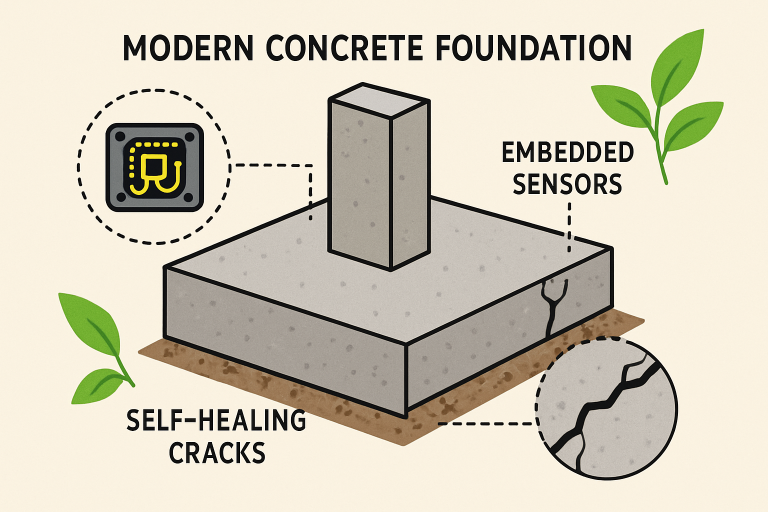
Self-healing concrete is transforming how foundations contend with cracking and environmental wear. This high-tech material incorporates microcapsules containing healing agents that activate when cracks form and moisture seeps in. The agents respond by sealing the cracks, restoring structural integrity, and minimizing further deterioration. As foundation longevity rapidly improves, this innovation holds the potential to cut repair costs and disruption for property owners. Businesses worldwide are rapidly adopting this technology, with some early studies and field data confirming significant improvements in the durability of critical infrastructure.
Smart Monitoring Systems
The advent of real-time structural health monitoring has significantly enhanced the way foundations are maintained. Smart sensors embedded within concrete can track environmental changes, movement, stress, and even moisture infiltration. Data from these sensors allows engineers and building owners to identify potential weaknesses early, facilitate proactive maintenance, and prevent small cracks or shifts from morphing into severe structural failures. This predictive capability reduces long-term repair costs and boosts occupant safety, particularly in regions prone to seismic or flood activity. Major innovations in this area feature wireless sensor networks, automatic reporting, and remote access via mobile devices.
Eco-Friendly Materials
Environmental sustainability is shaping the future of concrete foundation construction. Integrating recycled and renewable materials—such as fly ash, slag, and recycled aggregate—lowers the carbon footprint of new projects without compromising performance. Additionally, the push for carbon-neutral and low-impact mixes is gaining strength, helping to conserve resources and reduce emissions during manufacturing and curing. Research shows that these alternative mixes can outperform traditional options under various conditions, elevating green building standards across the construction sector.
Automated Construction Techniques
Automation is reshaping job sites worldwide. Robotic systems and advanced machinery can now pour and finish concrete with high accuracy and consistency, reducing errors, waste, and labor shortages. Automated mix design, placement, and curing processes ensure stricter quality control, faster project completion, and improved site safety. While initial investment may be significant, long-term savings are substantial due to increased efficiency and fewer rework incidents. The proliferation of 3D-printing technology for concrete also highlights a growing trend toward modular and prefabricated building methods.
Advanced Diagnostic Tools
Progress in diagnostic imaging and analytical technology has enabled non-destructive evaluation of concrete foundations. Tools such as muon tomography and deep learning–powered analysis provide highly detailed imaging to detect internal voids, cracks, and areas of concern before they compromise a structure. These advancements enable engineers to plan targeted repairs and ongoing maintenance with unprecedented precision, thereby safeguarding investments and enhancing long-term reliability. These technologies also support regulatory efforts to maintain heightened building safety in critical infrastructure. Read more about the evolving standards in foundation diagnostics from Scientific American. As the industry adopts advanced methods, property owners and developers can gain a deeper understanding of structural vulnerabilities, resulting in enhanced safety and lower repair costs. These innovations usher in a new era of resilient construction practices that enhance performance and provide peace of mind.
Precast and Modular Construction
Precast and modular schemes streamline both residential and commercial foundation work. By manufacturing components in controlled environments off-site, builders achieve exceptional precision and reduce waste, environmental disturbance, and on-site labor time. Once delivered, these components are quickly assembled, accelerating project timelines. Modular approaches are particularly effective in scaling projects and ensuring quality consistency—a critical factor for developers managing complex or repetitive builds. Industry reports suggest rapid growth in this sector as more contractors recognize the operational benefits and long-term savings.
Conclusion
The construction industry stands on the brink of a revolution, with concrete foundation technologies fundamentally changing design and building methods. By adopting these innovations, professionals and property owners gain not only stronger, longer-lasting foundations but also greener, more cost-efficient project outcomes. As the sector continues to evolve, staying current with trends and integrating cutting-edge solutions will be essential for ensuring durable and sustainable building practices into the future.