
From Melody to Milestone: The Impact of Arts Programs on Future Visionaries
Music education has long been associated with creativity and artistic expression, but its influence extends well beyond performance skills. Structured music programs help students develop cognitive abilities closely linked to innovation, including pattern recognition, problem-solving, collaboration, and disciplined practice. Learning to read music, understand rhythm, and perform as part of an ensemble requires both analytical thinking and adaptability—skills that are essential in science, technology, engineering, and other innovation-driven fields. As students navigate the challenges of mastering an instrument or composing music, they gain experience in experimentation, iteration, and constructive response to feedback.
Access to consistent music education, however, often depends on the availability of resources and institutional support. Initiatives like the Save The Music grants for music education are part of broader efforts that help schools sustain or reintroduce music programs, contributing to more equitable learning environments. Within the classroom, music programs create spaces where students can explore ideas freely while working within structured systems, mirroring the balance required in innovative work. By fostering both creativity and discipline, music education plays a meaningful role in shaping future innovators who are equipped to think critically, collaborate effectively, and approach complex challenges with confidence.
Table of Contents
Cognitive Benefits of Music Education
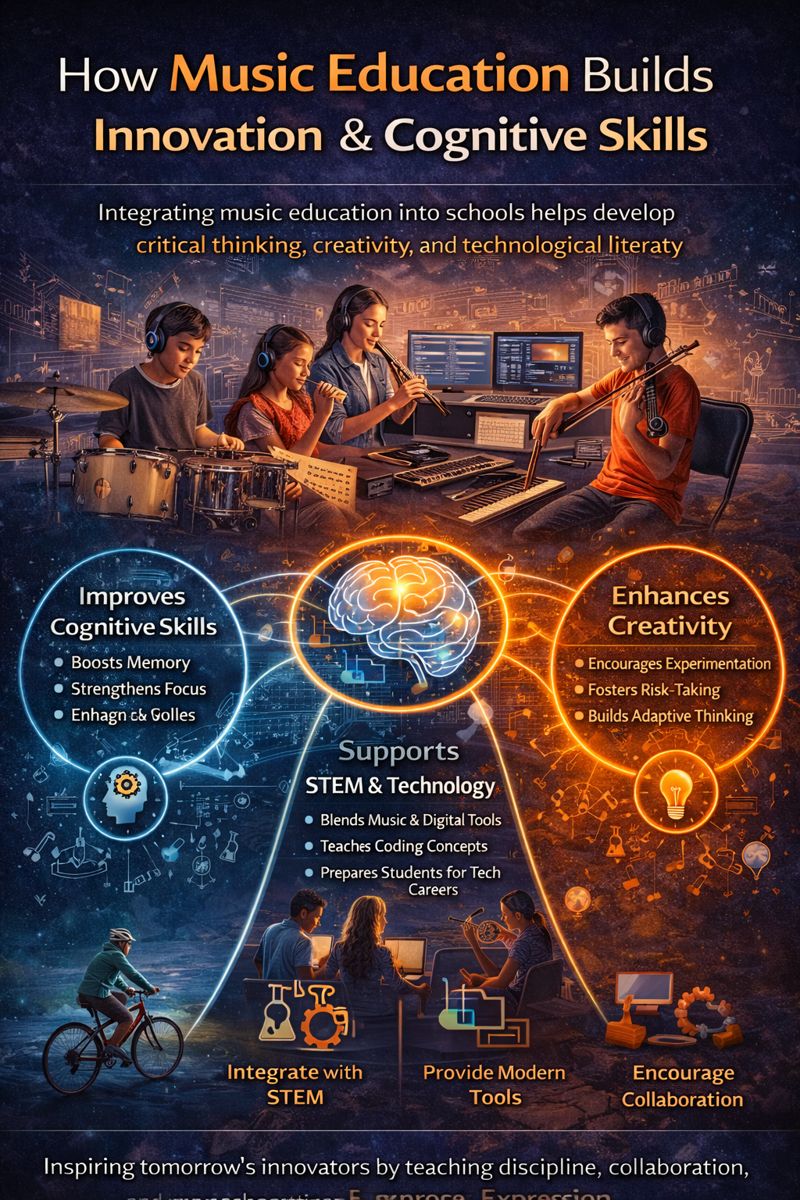
Engaging in music education offers measurable improvements in cognitive abilities. Musical training strengthens memory, attention span, and executive function, which are essential for effective learning and innovation. Reading music, coordinating group performances, and mastering new instruments stimulate both hemispheres of the brain, forging strong neural pathways. This brain activity can lead to sharper focus in all subject areas, including languages and mathematics, as students train their minds to recognize patterns, sequences, and subtle differences in sound.
Research published in Scientific American indicates that students involved in music consistently outperform their peers in areas such as verbal memory and mathematics. The discipline and focus demanded by music practice translate into improved capabilities for analyzing complex problems and generating creative solutions. Even brief periods of regular music instruction have been found to enhance reading comprehension and mathematical reasoning, equipping students with a robust toolkit for all types of academic pursuits.
Enhancing Creativity Through Musical Training
Creativity is at the heart of every great innovation. Music programs instill creativity by allowing students to improvise, compose, and interpret music in their own unique ways. These experiences give young learners the confidence to experiment and take risks, both of which are instrumental for innovation. Encouraged to leave their comfort zones, students learn the value of thinking differently and recognizing possibilities that lie beyond conventional methods.
When students are encouraged to create original compositions or reinterpret existing works, they must synthesize knowledge from multiple disciplines, draw on personal emotions, and communicate complex ideas—skills recognized as crucial in the modern workforce. The process of composition or improvisation fosters perseverance and builds resilience, as students refine their ideas and overcome obstacles to realize their creative vision. These habits of mind prepare them for any profession where adaptability and ingenuity are highly valued.
Music and Technology: A Synergistic Relationship
The intersection of music and technology provides new opportunities for inventive thinking. Music programs that incorporate digital tools such as MIDI controllers, synthesizers, and compositional software invite students to explore sound in entirely new ways. Exposure to music technology fosters technological literacy, preparing students for innovative roles in industries such as film, gaming, and software development. As technology rapidly evolves, gaining familiarity with these digital instruments allows students to creatively engineer soundtracks and design interactive audio experiences.
Academic institutions are increasingly blending these fields. At the Massachusetts Institute of Technology, for instance, students design new digital instruments and coding applications in music technology labs, challenging both musical and engineering norms. Learn more about these initiatives at MIT’s Music Technology Program. Such programs encourage interdisciplinary learning, motivating students to collaborate on projects that bring together skills from music, computer science, electrical engineering, and media arts. This approach mirrors the real-world demands of today’s most dynamic and innovative workplaces.
Implementing Music Programs in Schools
- Integrate Music with STEM: Develop interdisciplinary curricula that encourage students to see the connections between science, engineering, and the arts. For example, lessons might explore the mathematics of rhythm, the acoustics behind musical instruments, or the programming behind digital sound synthesis. By integrating music theory with physics and coding, students develop a well-rounded perspective that promotes real-world problem-solving and innovation.
- Provide Access to Technology: Equip schools with modern music production tools and software, allowing students to experiment with composition, mixing, and recording. This investment ensures that all students, regardless of background, gain exposure to the latest advancements in music technology. Accessible tools lower barriers for participation and encourage students to pursue new creative interests, helping foster equity within the arts and technology fields.
- Encourage Collaboration: Facilitate group projects where students work together to compose, perform, or engineer new pieces of music. Collaborative music-making strengthens communication and problem-solving skills, which are directly transferable to other fields. Supported by teachers and community artists, these group experiences teach respect, constructive critique, and the development of collective goals, all while building skills that lead to innovative breakthroughs.
- Support Creative Expression: Nurture an environment where students are free to explore diverse musical styles, develop their unique voice, and experiment without fear of failure. This freedom inspires resilience and adaptability—core components of innovative thinking. By welcoming a wide variety of musical perspectives, schools cultivate open-mindedness and a willingness to try untested ideas, traits essential for future leaders in any profession.
Conclusion
Music education is far more than an extracurricular activity; it is a key element in cultivating the innovative leaders of tomorrow. By enhancing cognitive skills, encouraging creativity, and integrating technological advancements, comprehensive music programs empower students to think differently and solve real-world problems. Schools and policymakers should prioritize and invest in music education to unlock the creative and innovative potential of every student. The benefits of music extend far beyond the stage or classroom—they shape communities, drive technological progress, and help pave the way for a more adaptable, inspired, and innovative new generation.